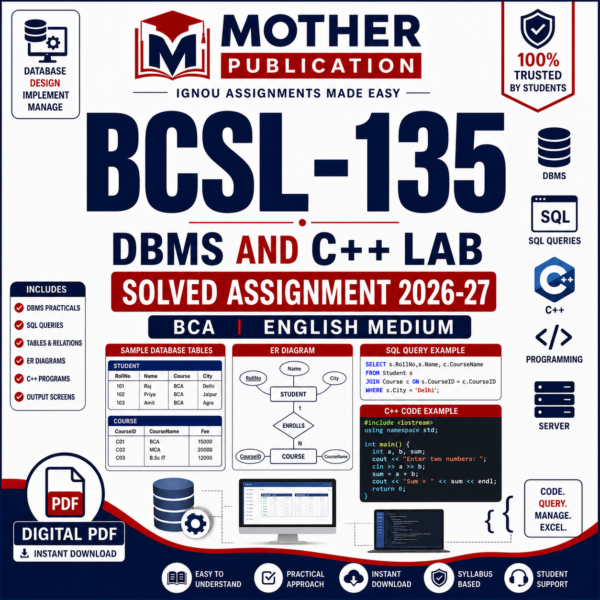
BCSL-135 Solved Assignment 2026-27 in English | Bachelor of Computer Applications
BCSL-135 Solved Assignment 2026-27 in English is designed for students of the Bachelor of Computer Applications (BCA) studying BCSL-135: DBMS and C++ Lab.
The supplied 2026-27 assignment is a practical project based on a Vehicle Service Management System. It combines Database Management System (DBMS) concepts with C++ application development.
The assignment carries 50 marks in total. It contains one main question divided into Section A and Section B, carrying 40 marks, while the remaining 10 marks are allocated to Viva Voce. Students are required to complete both sections.
BCSL-135 Course Information
| Particular | Details |
|---|---|
| Course Code | BCSL-135 |
| Course Title | DBMS and C++ Lab |
| Programme | Bachelor of Computer Applications |
| Programme Code | BCA_NEW / BCA_NEWOL |
| Semester | III |
| Medium | English |
| Session | 2026-27 |
| Assignment Code | BCA_NEW/BCAOL(III)L-135/Assign/2026-27 |
| Maximum Marks | 50 |
| Assignment Marks | 40 |
| Viva Voce | 10 |
| Main Question | 1 |
| Sections | 2 |
| Format | Digital PDF |
The assignment specifies the last dates as 31 October 2026 for the July 2026 Session and 30 April 2027 for the January 2027 Session.
BCSL-135 Assignment Project
Vehicle Service Management System
The complete practical project requires the design and development of a Vehicle Service Management System for an automobile service centre.
The project is divided into two parts:
Section A — Database Design and SQL
Students must design a database schema in Third Normal Form (3NF) and write SQL queries for the Vehicle Service Management System.
Section B — C++ Application Development
Students must develop a menu-driven C++ console application using classes and file handling to manage vehicle service records.
Section A — Database Schema
The database needs to store information relating to:
- Customers
- Vehicles
- Mechanics
- Service transactions
- Spare parts
- Service-part relationships
The database design includes unique identifiers and appropriate relationships between the entities.
Customer Table
The CUSTOMER table stores:
- Contact ID
- Customer Name
- Address
- Mobile Number
- Email Address
Contact_ID acts as the Primary Key.
Vehicle Table
The VEHICLE table stores:
- Vehicle ID
- Contact ID
- Registration Number
- Model
- Manufacturer
- Year of Manufacture
- Fuel Type
Vehicle_ID is the Primary Key, while Contact_ID is a Foreign Key referencing the CUSTOMER table. Registration numbers are unique.
Mechanic Table
The MECHANIC table stores:
- Mechanic ID
- Mechanic Name
- Specialization
- Experience
- Contact Number
Mechanic_ID is the Primary Key.
Service Table
The SERVICE table stores:
- Service ID
- Vehicle ID
- Mechanic ID
- Service Date
- Service Type
- Labour Charges
- Spare Parts Cost
- Total Bill Amount
The service table connects each service transaction with a vehicle and mechanic.
Spare Part Table
The SPARE_PART table stores:
- Part ID
- Part Name
- Unit Price
Part_ID acts as the Primary Key.
Service Part Table
The SERVICE_PART table resolves the many-to-many relationship between services and spare parts.
It contains:
- Service ID
- Part ID
- Quantity
The combination of Service_ID and Part_ID forms the composite Primary Key.
ER Diagram and Relationships
The database design includes an ER Diagram showing:
- Customer → Vehicle: One-to-Many
- Vehicle → Service: One-to-Many
- Mechanic → Service: One-to-Many
- Service ↔ Spare Part: Many-to-Many
The many-to-many Service–Spare Part relationship is resolved using the SERVICE_PART table.
3NF Justification
The proposed database follows Third Normal Form (3NF) by separating customer, vehicle, mechanic, service and spare-part information into appropriate tables.
The design reduces repeated data and unnecessary dependencies while maintaining relationships through Primary Keys and Foreign Keys.
Section A — SQL Queries
The assignment requires 10 SQL queries for the designed database:
- Display customer name, vehicle registration number, service date and service type for vehicles serviced during a specified month.
- List customers who own more than one vehicle.
- Display each mechanic and the total number of vehicles serviced by that mechanic.
- Find vehicles that have never undergone servicing.
- Display the service history of a specified vehicle chronologically.
- Calculate total service expenditure incurred by each customer.
- Retrieve vehicles whose total service cost exceeds ₹50,000.
- Display average labour charges for each service type.
- List spare parts replaced during a specified service transaction.
- Display the top five customers according to vehicle-service expenditure.
The solved assignment uses appropriate SQL concepts including:
JOINLEFT JOINGROUP BYHAVINGORDER BY- Aggregate functions
SUM()AVG()COUNT()COALESCE()LIMIT- Subqueries
For example, COUNT(DISTINCT Vehicle_ID) ensures that a vehicle serviced multiple times by the same mechanic is counted only once.
Section B — C++ Application Development
The second section requires a menu-driven C++ console application for the Vehicle Service Management System.
The application must use classes and file handling to manage records.
Customer Class
The Customer class stores:
- Customer ID
- Customer Name
- Address
- Mobile Number
- Email Address
It includes constructors, getter and setter functions and a display function.
Vehicle Class
The Vehicle class stores:
- Vehicle ID
- Registration Number
- Model
- Manufacturer
- Year of Manufacture
- Fuel Type
It includes suitable constructors and member functions.
Service Class
The Service class stores:
- Service ID
- Customer ID
- Vehicle ID
- Mechanic ID
- Service Date
- Service Type
- Labour Charges
- Spare Parts Cost
- Total Bill Amount
The class includes functions for calculating the total bill and for adding, modifying, searching and displaying service records.
The total bill is automatically calculated as:
Total Bill = Labour Charges + Spare Parts Cost
File Handling
The C++ application uses the following files:
customers.datvehicles.datservices.dat
Existing records are loaded when the application starts, and updated records are saved when the user exits the application.
The solved program uses fstream for file handling and provides persistent storage so that records are retained after closing the application.
Menu-Driven Interface
The application provides options for:
- Register New Customer
- Register New Vehicle
- Record Vehicle Service
- Search Vehicle
- Search Customer
- Update Service
- Delete Service
- Display All Customers
- Display All Vehicles
- Display Complete Service History
- Generate Vehicle Service Bill
- Exit
These functions provide the basic management interface required by the assignment.
Input Validation
The program validates important conditions including:
- Vehicle registration number must be unique.
- Mobile number must contain exactly 10 digits.
- Labour charges cannot be negative.
- Spare-parts cost cannot be negative.
- Total bill must be calculated automatically.
- A service cannot be created unless the required customer and vehicle are already registered.
- Appropriate error messages should be displayed for invalid input.
The solved C++ application implements these validation requirements and uses classes to provide encapsulation of customer, vehicle and service data.
What This BCSL-135 Solved Assignment Includes
The BCSL-135 Solved Assignment 2026-27 in English covers the complete practical project from database planning through C++ application development.
It includes:
- Vehicle Service Management System
- 3NF database design
- ER Diagram
- CUSTOMER table
- VEHICLE table
- MECHANIC table
- SERVICE table
- SPARE_PART table
- SERVICE_PART table
- Primary Keys
- Foreign Keys
- Database relationships
- 3NF justification
- 10 SQL queries
- JOIN operations
- Aggregate functions
- GROUP BY and HAVING
- C++ classes
- Constructors
- Getter and setter functions
- File handling
- Menu-driven application
- Input validation
- Service bill generation
- Complete service history
Key Features
- BCSL-135 DBMS and C++ Lab
- Solved Assignment 2026-27
- English Medium
- BCA Semester III
- Complete practical project
- DBMS database design
- 3NF schema
- ER Diagram
- SQL queries
- C++ programming
- Object-oriented programming
- Classes and objects
- File handling
- Menu-driven application
- Input validation
- Vehicle Service Management System
- Digital PDF format
- Instant Download
Important Assignment Information
Course Code: BCSL-135
Course Title: DBMS and C++ Lab
Assignment Code: BCA_NEW/BCAOL(III)L-135/Assign/2026-27
Maximum Marks: 50
Assignment Marks: 40
Viva Voce: 10
Main Question: 1
Sections: 2
July 2026 Submission: 31 October 2026
January 2027 Submission: 30 April 2027
Frequently Asked Questions
1. What is BCSL-135?
BCSL-135 is DBMS and C++ Lab.
2. Which programme is BCSL-135 for?
It is for students of the Bachelor of Computer Applications (BCA) programme.
3. What is the BCSL-135 assignment code?
BCA_NEW/BCAOL(III)L-135/Assign/2026-27.
4. What is the maximum mark?
The maximum is 50 marks, including 40 assignment marks and 10 Viva Voce marks.
5. How many questions are in BCSL-135?
There is one main question divided into two sections. Both sections must be completed.
6. What is the project in BCSL-135?
The project is a Vehicle Service Management System.
7. What does Section A contain?
Section A covers 3NF database design, ER Diagram, tables, Primary Keys, Foreign Keys and 10 SQL queries.
8. What does Section B contain?
Section B requires a menu-driven C++ application using classes and file handling.
9. Which files are used by the C++ application?
The application uses customers.dat, vehicles.dat and services.dat for persistent record storage.
10. What are the submission dates?
The supplied assignment states 31 October 2026 for July 2026 and 30 April 2027 for January 2027.
Disclaimer
This material is independently prepared by Mother Publication for educational and reference purposes. Students should read, understand and appropriately use the material while preparing their assignments. Mother Publication is not affiliated with, endorsed by, or officially associated with IGNOU.
PRODUCT TAGS
BCSL-135, BCSL 135, BCSL135, BCSL-13, BCSL 13, BCSL13, BCSL-135 Solved Assignment 2026-27, BCSL 135 Solved Assignment 2026-27, BCSL135 Solved Assignment 2026-27, BCSL-13 Solved Assignment 2026-27, BCSL 13 Solved Assignment 2026-27, BCSL13 Solved Assignment 2026-27, BCSL-135 Solved Assignment 2027, BCSL 135 Solved Assignment 2027, BCSL135 Solved Assignment 2027, BCSL-13 Assignment 2027, BCSL 13 Assignment 2027, BCSL13 Assignment 2027, BCSL-135 DBMS and C++ Lab, BCSL 135 DBMS and C++ Lab, BCSL135 DBMS and C++ Lab, DBMS and C++ Lab Assignment 2026-27, DBMS and C++ Lab Solved Assignment, DBMS and C++ Lab PDF, BCSL-135 Assignment PDF, BCSL 135 Assignment PDF, BCSL135 Assignment PDF, BCA BCSL-135, BCA DBMS Lab, BCA C++ Lab, BCA Solved Assignment 2026-27, BCA Assignment PDF 2026-27, Bachelor of Computer Applications Assignment, BCSL-135 English Medium, BCSL 135 English Medium, BCSL135 English Medium, BCSL-135 2026-27, BCSL 135 2026-27, BCSL135 2027, BCSL-135 Solved PDF, BCSL-135 Assignment Questions, BCSL-135 Question Paper, BCSL-135 Solution, BCSL-135 Answers, BCSL-135 DBMS, BCSL-135 Database Management System, BCSL-135 SQL, BCSL-135 SQL Queries, BCSL-135 ER Diagram, BCSL-135 3NF, BCSL-135 Normalization, BCSL-135 C++ Programming, BCSL-135 Classes and Objects, BCSL-135 File Handling, BCSL-135 Vehicle Service Management System, BCSL-135 C++ Application, BCSL-135 Menu Driven Program, BCSL-135 Input Validation, BCSL-135 Database Design, BCSL-135 Primary Key, BCSL-135 Foreign Key, BCSL-135 2026-27 PDF