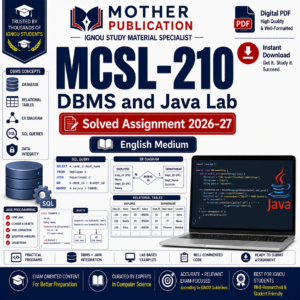
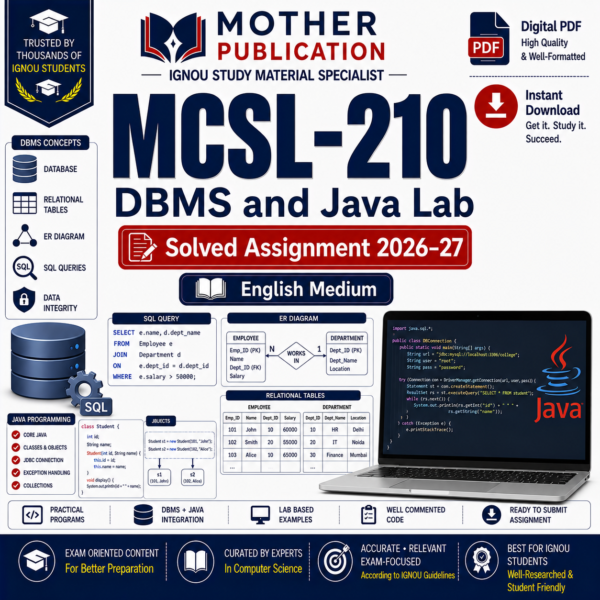
MCSL-210 Solved Assignment 2026-27 in English | PGDCA
The MCSL-210 Solved Assignment 2026-27 in English is prepared for students studying MCSL-210: DBMS and Java Lab under the Post Graduate Diploma in Computer Applications (PGDCA_NEW) programme.
IGNOU lists MCSL-210 as a 2-credit practical/lab course in Semester II. The course is based on the practical components of Database Management Systems and Object-Oriented Programming using Java.
MCSL-210 Course Information
| Particular | Details |
|---|---|
| Course Code | MCSL-210 |
| Course Title | DBMS and Java Lab |
| Programme | Post Graduate Diploma in Computer Applications |
| Programme Code | PGDCA_NEW |
| Semester | II |
| Course Type | Practical / Lab |
| Credits | 2 |
| Medium | English |
| Session | 2026-27 |
| Assignment Marks | 100 |
| Assignment Weightage | 30% |
| Format | Digital PDF |
| Delivery | Instant Download |
The current IGNOU assignment portal lists MCSL-210 under PGDCA_NEW, English medium, for July 2026 and January 2027, with 100 maximum marks and 30% weightage.
MCSL-210 Solved Assignment 2026-27 Overview
MCSL-210 is a practical course combining two important areas of computer applications:
- Database Management Systems
- Java Programming
The course provides practical exposure to designing databases, implementing relational database structures, writing SQL queries and developing Java programs.
IGNOU describes MCSL-210 as a laboratory course based on Object Oriented Programming using Java and Database Management Systems.
Major Topics Covered
- Database Management Systems
- Database Design
- ER Diagrams
- Entities and Attributes
- Relationships
- Primary Keys
- Foreign Keys
- Referential Integrity
- Relational Database
- Database Tables
- Normalization
- First Normal Form
- Second Normal Form
- Third Normal Form
- SQL
- DDL Commands
- DML Commands
- SELECT Queries
- WHERE Clause
- ORDER BY
- GROUP BY
- Aggregate Functions
- Joins
- Subqueries
- Database Constraints
- Java Programming
- Object-Oriented Programming
- Classes and Objects
- Constructors
- Methods
- Inheritance
- Polymorphism
- Encapsulation
- Abstraction
- Exception Handling
- Arrays
- Strings
- File Handling
- Java Input/Output
- Program Logic
- Sample Input and Output
- Practical Documentation
DBMS Lab
The DBMS portion of MCSL-210 provides practical experience in designing and implementing relational databases.
Students work with database concepts such as:
- Entities
- Attributes
- Relationships
- Keys
- Constraints
- Tables
- SQL commands
- Database normalization
- Referential integrity
Database Design
Database design is the process of organizing data into suitable tables and defining relationships between them.
A proper database design helps to:
- Reduce data redundancy
- Maintain consistency
- Improve data organization
- Enforce relationships
- Simplify data retrieval
- Maintain data integrity
ER Diagram
An Entity Relationship Diagram (ER Diagram) provides a visual representation of entities, attributes and relationships within a database system.
Important ER concepts include:
- Entity
- Attribute
- Relationship
- Primary key
- Cardinality
- Participation
- Generalization
- Specialization
Relational Database Tables
After designing an ER model, the entities and relationships can be converted into relational tables.
A properly designed table generally contains:
- Table name
- Columns
- Data types
- Primary key
- Foreign keys
- Constraints
Primary Key
A primary key uniquely identifies each record in a table.
Important characteristics include:
- Uniqueness
- No duplicate values
- Identification of individual records
- Entity integrity
Foreign Key
A foreign key establishes a relationship between tables by referring to a primary key or suitable candidate key in another table.
Foreign keys help maintain referential integrity.
Database Normalization
Normalization organizes data to reduce unnecessary duplication and improve consistency.
Important normal forms include:
First Normal Form
1NF requires atomic values and avoids repeating groups.
Second Normal Form
2NF builds on 1NF and removes partial dependency where applicable.
Third Normal Form
3NF further reduces transitive dependencies and improves relational database design.
SQL Programming
SQL is used to create, modify, retrieve and manage data in relational databases.
Important SQL commands include:
- CREATE
- ALTER
- INSERT
- UPDATE
- DELETE
- SELECT
- DROP
SQL Queries
SQL queries can be used to retrieve specific information from database tables.
Common clauses and operations include:
- WHERE
- ORDER BY
- GROUP BY
- HAVING
- DISTINCT
- LIKE
- BETWEEN
- IN
- Aggregate functions
- Joins
- Subqueries
Java Lab
The Java portion of MCSL-210 provides practical programming experience using Java and object-oriented programming concepts.
The practical work focuses on writing, executing and documenting Java programs.
Object-Oriented Programming
Object-Oriented Programming organizes programs around objects and classes.
The major OOP principles include:
- Encapsulation
- Inheritance
- Polymorphism
- Abstraction
Classes and Objects
A class defines the structure and behaviour of objects.
An object is an instance of a class and can contain:
- Data
- Methods
- Behaviour
Constructors
Constructors are used for initializing objects when they are created.
They have the same name as their class and do not have a return type.
Inheritance
Inheritance allows one class to acquire properties and methods from another class.
It promotes:
- Code reuse
- Hierarchical design
- Extensibility
- Maintainability
Polymorphism
Polymorphism allows the same interface or method name to represent different behaviours.
Java supports polymorphism through mechanisms such as:
- Method overloading
- Method overriding
Exception Handling
Exception handling allows Java programs to respond appropriately to runtime problems.
Important Java keywords include:
- try
- catch
- finally
- throw
- throws
Arrays and Strings
Java arrays store collections of values of the same type.
String handling is also an important part of Java programming and is commonly used for processing textual information.
File Handling
Java provides classes and APIs for reading from and writing to files.
File-handling operations can be used for:
- Creating files
- Reading files
- Writing files
- Updating data
- Processing stored information
Program Logic and Documentation
Practical assignments require more than simply writing source code.
A properly documented practical solution can include:
- Problem statement
- Algorithm
- Program logic
- Source code
- Sample input
- Sample output
- Explanation
- Comments
- Result
Previous official MCSL-210 assignment formats explicitly require students to execute programs and submit program logic, sample input/output and necessary documentation.
DBMS and Java Integration
DBMS and Java are important together in application development.
Java applications can communicate with databases to:
- Insert records
- Retrieve records
- Update records
- Delete records
- Generate reports
- Process database information
This combination forms an important foundation for developing database-driven applications.
Applications of MCSL-210
The practical skills covered by MCSL-210 can be applied in:
- Database applications
- Business software
- E-commerce systems
- Banking applications
- Student management systems
- Inventory systems
- Employee management systems
- Web applications
- Desktop applications
- Enterprise software
What Does This MCSL-210 Solved Assignment PDF Include?
The MCSL-210 Solved Assignment 2026-27 in English provides structured practical reference material covering both major components of the course:
DBMS Lab
- Database design
- ER diagrams
- Relational tables
- Keys
- Constraints
- Normalization
- SQL commands
- SQL queries
- Database implementation
- Query output and explanation
Java Lab
- Java programming
- Object-oriented programming
- Classes and objects
- Methods
- Constructors
- Inheritance
- Polymorphism
- Exception handling
- Arrays and strings
- File handling
- Program logic
- Sample input/output
- Practical documentation
Key Features
- MCSL-210 course-specific content
- DBMS and Java Lab
- 2026-27 session
- English Medium
- PGDCA_NEW programme
- Semester II
- Practical / Lab course
- 2-credit course
- Database design
- ER diagrams
- SQL queries
- Normalization
- Java programming
- Object-oriented programming
- Program logic
- Sample input/output
- Practical documentation
- Structured reference solutions
- Digital PDF format
- Mobile and desktop friendly
- Instant Digital Download
Who Can Use This MCSL-210 Assignment?
This product is intended for students enrolled in PGDCA_NEW who are preparing MCSL-210: DBMS and Java Lab for the 2026-27 assignment cycle.
IGNOU’s current assignment portal identifies PGDCA_NEW as the programme for MCSL-210.
Important Assignment Information
| Particular | Details |
|---|---|
| Course Code | MCSL-210 |
| Course Title | DBMS and Java Lab |
| Programme Code | PGDCA_NEW |
| Semester | II |
| Course Type | Practical / Lab |
| Credits | 2 |
| Medium | English |
| Session | July 2026 & January 2027 |
| Maximum Marks | 100 |
| Assignment Weightage | 30% |
| July 2026 Due Date | 31 October 2026 |
| January 2027 Due Date | 30 April 2027 |
The current IGNOU assignment portal confirms MCSL-210 for July 2026 and January 2027 with 100 marks and 30% weightage; the listed submission dates are 31 October 2026 for the July session and 30 April 2027 for the January session.
How to Get This MCSL-210 PDF
Step 1: Add the Product
Select the MCSL-210 Solved Assignment 2026-27 in English product and add it to your cart.
Step 2: Complete Payment
Complete checkout using the available payment option.
Step 3: Get Instant Access
After successful order completion, access the digital product through the website.
Step 4: Download the PDF
Download the MCSL-210 PDF on your mobile, tablet or computer.
Step 5: Prepare Your Assignment
Read the assignment questions carefully and use the solved material as academic reference while preparing your practical assignment according to the applicable IGNOU guidelines.
FAQ
1. What is MCSL-210?
MCSL-210 is DBMS and Java Lab.
2. Which programme is applicable to MCSL-210?
PGDCA_NEW.
3. Is MCSL-210 a theory or practical course?
MCSL-210 is a Practical / Lab course carrying 2 credits.
4. What is the medium?
English Medium.
5. Which semester is MCSL-210?
MCSL-210 is a Semester II course.
6. Which session does this product cover?
2026-27, covering the July 2026 and January 2027 assignment cycle.
7. What are the maximum assignment marks?
100 marks.
8. What is the assignment weightage?
30%.
9. What subjects are covered in MCSL-210?
MCSL-210 combines practical work based on Database Management Systems and Object-Oriented Programming using Java.
10. Does MCSL-210 include SQL?
Yes. The DBMS component involves database implementation and SQL-based practical work.
11. Does MCSL-210 include Java programming?
Yes. Java programming and object-oriented programming form the second major component of the lab.
12. Does the practical work require program execution?
Yes. Official MCSL-210 assignment formats require students to execute programs and provide program logic, sample input/output and documentation.
13. Is this product available in English?
Yes. This product is for English Medium students.
Disclaimer
Mother Publication independently prepares this material for educational and reference purposes. Students should understand the content and prepare their assignments appropriately. Mother Publication is not affiliated with, endorsed by, or officially associated with IGNOU.
Product Tags
MCSL-210, MCSL 210, MCSL210, MCSL-210 solved assignment 2026-27, MCSL 210 solved assignment 2026-27, MCSL210 solved assignment 2026-27, MCSL-210 solved assignment 2027, MCSL 210 solved assignment 2027, MCSL210 solved assignment 2027, MCSL-210 assignment 2027, MCSL 210 assignment 2027, MCSL210 assignment 2027, MCSL-210 solved assignment, MCSL 210 solved assignment, MCSL210 solved assignment, DBMS and Java Lab assignment, DBMS and Java Lab solved assignment, DBMS and Java Lab PDF, MCSL-210 PDF, MCSL-210 assignment PDF, MCSL-210 solved PDF, MCSL-210 2026-27, MCSL-210 2027, MCSL 210 2026-27, MCSL210 2027, PGDCA assignment, PGDCA solved assignment 2026-27, PGDCA_NEW assignment, MCSL-210 English assignment, MCSL-210 English medium, MCSL-210 DBMS assignment, MCSL-210 Java assignment, MCSL-210 DBMS lab, MCSL-210 Java lab, MCSL-210 database assignment, MCSL-210 database design assignment, MCSL-210 ER diagram assignment, MCSL-210 SQL assignment, MCSL-210 SQL queries, MCSL-210 relational database assignment, MCSL-210 normalization assignment, MCSL-210 primary key assignment, MCSL-210 foreign key assignment, MCSL-210 Java programming assignment, MCSL-210 OOP assignment, MCSL-210 object oriented programming assignment, MCSL-210 classes and objects assignment, MCSL-210 inheritance assignment, MCSL-210 polymorphism assignment, MCSL-210 exception handling assignment, MCSL-210 Java program, MCSL-210 Java practical, MCSL-210 DBMS practical, MCSL-210 lab practical, MCSL-210 program logic, MCSL-210 sample input output, MCSL-210 solved PDF 2026-27, MCSL210 solved PDF, MCSL 210 solved PDF, PGDCA MCSL-210 assignment 2026-27.