MGG-010 Solved Assignment 2026-27 in English | MSCGG
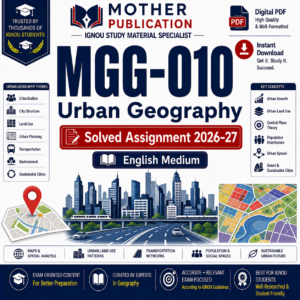
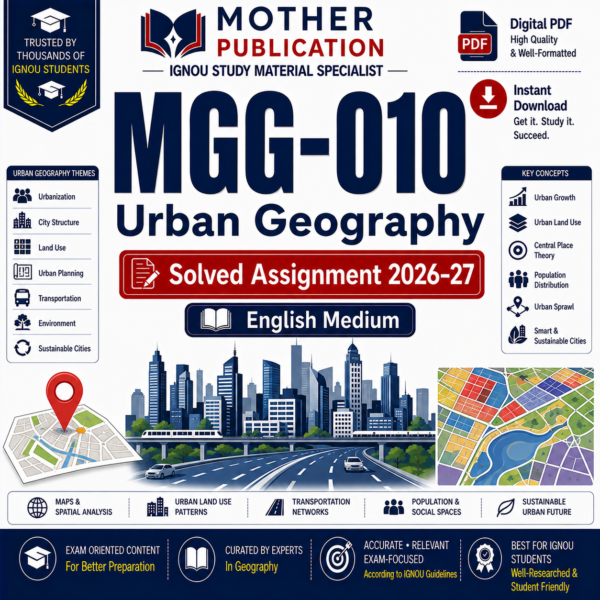
The MGG-010 Solved Assignment 2026-27 in English is prepared for students studying MGG-010: Urban Geography under the MSCGG programme.
The 2026-27 assignment is identified as MGG-010/TMA/2026-27 and carries 100 maximum marks. The assignment covers important concepts, theories, methods and contemporary issues related to Urban Geography.
MGG-010 Course Information
Course Code: MGG-010
Course Title: Urban Geography
Programme: MSCGG
Medium: English
Session: 2026-27
Assignment Type: Tutor Marked Assignment
Assignment Code: MGG-010/TMA/2026-27
Maximum Marks: 100
Format: Digital PDF
Delivery: Instant Download
MGG-010 Solved Assignment 2026-27 Overview
MGG-010 focuses on the geographical study of cities, towns and urban settlements. It examines urban location, distribution, development, morphology, functions and relationships between cities and their surrounding regions.
The solved assignment discusses changing approaches to Urban Geography, Indian contributions to the discipline, statistical classification of cities, primate city patterns, the informal urban economy, urban land-use theories, urban morphology and important contemporary urban issues.
Major Topics Covered
- Definition of Urban Geography
- Changing Approaches to Urban Geography
- Contribution of Indian Geographers
- Statistical Method and Functional Classification of Cities
- Primate City Pattern
- Size and Distribution of Cities
- Urban Informal Economy
- Features of the Urban Informal Sector
- Concentric Zone Theory
- Urban Land Use
- Schools of Thought in Urban Morphology
- Sphere of Influence of a City
- Pull and Push Factors
- Urban Poverty
- Urban Flooding
- Urban Planning
- Sustainable Urbanisation
These topics correspond to the questions included in the MGG-010/TMA/2026-27 assignment.
Urban Geography
Urban Geography is an important branch of Human Geography concerned with the study of cities, towns and urban settlements.
It examines:
- Location of cities
- Distribution of urban settlements
- Urban growth
- Urban morphology
- Urban functions
- Land use
- Population
- Transportation
- Housing
- Urban planning
- Economic activities
- Environmental problems
Urban Geography also studies the relationship between cities and their surrounding regions.
Changing Approaches to Urban Geography
Urban Geography has developed through different approaches over time.
Traditional Approach
The traditional approach mainly focused on the description of cities, their origin, location, historical development, physical characteristics, urban morphology and classification of settlements.
Quantitative Approach
The quantitative approach introduced statistical techniques, mathematical models and measurable data into Urban Geography.
It helped researchers study urban patterns, population distribution, accessibility, functional classification and spatial relationships systematically.
Contribution of Indian Geographers
Indian geographers have contributed significantly to the development of Urban Geography in India.
Their work has helped in understanding:
- Indian urbanisation
- Urban hierarchy
- City functions
- Urban morphology
- Population distribution
- Urban growth
- Regional differences
- Urban planning
The MGG-010 assignment specifically asks students to discuss the contribution of Indian geographers to the development of Urban Geography.
Statistical Method and Functional Classification of Cities
Statistical methods are useful for classifying cities according to their dominant functions.
Functional classification can identify cities based on activities such as:
- Administration
- Industry
- Commerce
- Transport
- Education
- Tourism
- Services
Statistical analysis helps compare the relative importance of different urban functions and understand the specialization of cities.
Primate City Pattern
A primate city is a city that is disproportionately larger and more influential than other cities within the same urban system.
The primate city pattern helps explain differences in the size and distribution of cities and the concentration of economic, political and administrative activities.
Urban Informal Economy
The urban informal sector includes economic activities that operate outside or partly outside formal regulatory and institutional structures.
Important characteristics include:
- Easy entry
- Small-scale operations
- Labour-intensive activities
- Limited capital
- Lack of formal registration
- Irregular income
- Limited social security
- Flexible employment
- Important contribution to the urban economy
The informal sector provides employment and affordable goods and services to many urban residents, although workers may face low wages, uncertain employment and limited social protection.
Concentric Zone Theory of Urban Land Use
The Concentric Zone Theory was proposed by Ernest W. Burgess in 1925 to explain the spatial structure and growth of cities.
According to the theory, cities expand outward from a central point through a series of concentric zones.
The five major zones are:
- Central Business District (CBD)
- Zone of Transition
- Working-Class Residential Zone
- Better Residential Zone
- Commuter Zone
The theory helped explain processes such as urban expansion, invasion, succession and social segregation. However, modern cities do not always develop in perfect circular patterns because transportation networks, physical barriers, planning regulations and multiple business centres influence urban development.
Schools of Thought in Urban Morphology
Urban morphology studies the physical form and spatial structure of cities.
Different schools of thought have examined:
- Street patterns
- Building forms
- Land-use patterns
- Urban structure
- Historical development
- Functional zones
- Transformation of urban landscapes
The MGG-010 assignment specifically requires discussion of the different schools of thought related to urban morphology.
Sphere of Influence of a City
The sphere of influence refers to the geographical area surrounding a city that depends on or interacts with the city for different services and functions.
People from surrounding areas may travel to the city for:
- Shopping
- Education
- Healthcare
- Employment
- Administration
- Entertainment
- Other specialized services
Pull and Push Factors
Push and pull factors influence the movement of people.
Push Factors
Push factors encourage people to leave a place. Examples include:
- Unemployment
- Poverty
- Lack of services
- Natural disasters
- Social insecurity
- Limited economic opportunities
Pull Factors
Pull factors attract people towards another place. Examples include:
- Employment opportunities
- Better education
- Healthcare
- Higher income
- Better infrastructure
- Improved living conditions
These factors are important for understanding migration and urban population growth.
Urban Poverty
Urban poverty refers to poverty experienced by people living in urban areas.
It may be associated with:
- Unemployment
- Low income
- Inadequate housing
- Informal employment
- Poor sanitation
- Limited access to services
- Social exclusion
Rapid urbanisation without adequate planning can increase the concentration of vulnerable populations in disadvantaged urban areas.
Urban Flooding
Urban flooding occurs when rainfall or other water flows exceed the capacity of urban drainage systems.
Major causes can include:
- Heavy rainfall
- Poor drainage
- Encroachment on natural drainage channels
- Reduction of permeable surfaces
- Unplanned urbanisation
- Inadequate storm-water management
Urban flooding can damage houses, roads, infrastructure and public services and can create serious health and environmental problems.
Urban Planning
Urban planning involves the systematic planning and management of urban development.
It deals with:
- Land use
- Housing
- Transportation
- Infrastructure
- Public spaces
- Environmental management
- Basic services
- Future urban growth
Effective urban planning can help create more efficient, inclusive and sustainable cities.
Sustainable Urbanisation
Sustainable urbanisation aims to balance urban economic development, social well-being and environmental protection.
Important aspects include:
- Sustainable transport
- Affordable housing
- Efficient infrastructure
- Waste management
- Green spaces
- Environmental protection
- Inclusive development
- Climate-resilient cities
Sustainable urbanisation is increasingly important because of rapid population growth and expanding cities.
What Does This MGG-010 Solved Assignment PDF Include?
The MGG-010 Solved Assignment 2026-27 in English provides structured reference solutions corresponding to the 2026-27 assignment.
It covers:
- Urban Geography
- Changing approaches to Urban Geography
- Indian geographers and Urban Geography
- Functional classification of cities
- Statistical methods
- Primate city pattern
- Urban informal economy
- Concentric Zone Theory
- Urban land use
- Urban morphology
- Sphere of influence
- Pull and push factors
- Urban poverty
- Urban flooding
- Urban planning
- Sustainable urbanisation
The uploaded assignment contains these questions across Part-A, Part-B and Part-C.
Key Features
- MGG-010 course-specific content
- Urban Geography
- 2026-27 session
- English Medium
- MSCGG programme
- Tutor Marked Assignment
- Assignment Code MGG-010/TMA/2026-27
- Maximum Marks 100
- Structured reference solutions
- Urban Geography concepts
- Urban land-use theories
- Urban morphology
- Functional classification of cities
- Urban informal economy
- Urban poverty
- Urban flooding
- Urban planning
- Sustainable urbanisation
- Digital PDF format
- Mobile and desktop friendly
- Instant Digital Download
Who Can Use This MGG-010 Assignment?
This product is intended for students studying MGG-010: Urban Geography under the applicable MSCGG programme and preparing the 2026-27 assignment.
Important Assignment Information
Course Code: MGG-010
Course Title: Urban Geography
Assignment Code: MGG-010/TMA/2026-27
Programme: MSCGG
Medium: English
Session: 2026-27
Maximum Marks: 100
Assignment Type: Tutor Marked Assignment
The course code, course title, assignment code, maximum marks and question structure are taken from the uploaded MGG-010 2026-27 assignment.
How to Get This MGG-010 PDF
Step 1: Add the Product
Select MGG-010 Solved Assignment 2026-27 in English and add it to your cart.
Step 2: Complete Payment
Complete checkout using the available payment option.
Step 3: Get Digital Access
After successful order completion, access the digital product through the website.
Step 4: Download the PDF
Download the MGG-010 PDF on your mobile, tablet or computer.
Step 5: Prepare Your Assignment
Read the original assignment questions carefully and use the solved material as academic reference while preparing your assignment.
FAQ
1. What is MGG-010?
MGG-010 is Urban Geography.
2. What is the assignment code?
The assignment code is MGG-010/TMA/2026-27.
3. What are the maximum marks?
The assignment carries 100 maximum marks.
4. Which programme is applicable?
The product is prepared for MSCGG students.
5. What is the medium?
English Medium.
6. Which session does this product cover?
2026-27.
7. What topics are covered?
The assignment covers Urban Geography, changing approaches, functional classification of cities, primate cities, informal economy, urban land-use theories, urban morphology, urban poverty, flooding, planning and sustainable urbanisation.
8. Is this a solved assignment PDF?
Yes. It is a digital PDF containing structured reference solutions for the MGG-010 2026-27 assignment.
9. Is the product available in English?
Yes, this product is for English Medium students.
Disclaimer
Mother Publication independently prepares this material for educational and reference purposes. Students should understand the content and prepare their assignments appropriately. Mother Publication is not affiliated with, endorsed by, or officially associated with IGNOU.
Product Tags
MGG-010, MGG 010, MGG010, MGG-10, MGG 10, MGG10, MGG-010 solved assignment 2026-27, MGG 010 solved assignment 2026-27, MGG010 solved assignment 2026-27, MGG-10 solved assignment 2026-27, MGG 10 solved assignment 2026-27, MGG10 solved assignment 2026-27, MGG-010 solved assignment 2027, MGG 010 solved assignment 2027, MGG010 solved assignment 2027, MGG-10 solved assignment 2027, MGG 10 solved assignment 2027, MGG10 solved assignment 2027, MGG-010 assignment 2027, MGG 010 assignment 2027, MGG010 assignment 2027, MGG-010 solved assignment, MGG 010 solved assignment, MGG010 solved assignment, Urban Geography assignment, Urban Geography solved assignment, Urban Geography PDF, MGG-010 PDF, MGG-010 assignment PDF, MGG-010 solved PDF, MGG-010 2026-27, MGG-010 2027, MGG 010 2026-27, MGG010 2027, MSCGG assignment, MSCGG solved assignment 2026-27, MGG-010 English assignment, MGG-010 English medium, MGG-010 Urban Geography, MGG-010 urban geography assignment, MGG-010 urban geography solved assignment, MGG-010 urban geography PDF, MGG-010 urban informal economy, MGG-010 concentric zone theory, MGG-010 urban morphology, MGG-010 functional classification of cities, MGG-010 primate city, MGG-010 urban poverty, MGG-010 urban flooding, MGG-010 urban planning, MGG-010 sustainable urbanisation, MGG-010 sphere of influence, MGG-010 pull and push factors, MGG-010 solved PDF 2026-27, MGG010 solved PDF, MGG 010 solved PDF, MSCGG MGG-010 assignment 2026-27.