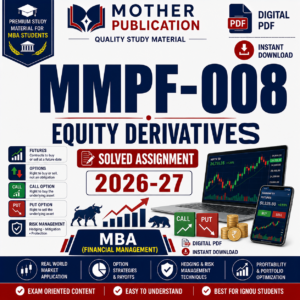
MMPF-008 Solved Assignment 2026-27 in English | MBA (Financial Management)
MMPF-008 Solved Assignment 2026-27 in English is prepared for the course MMPF-008: Equity Derivatives. The assignment covers all blocks and contains five questions dealing with Indian capital-market instruments, futures contracts, option contracts, derivatives-market participants, and OTC and exchange-traded derivatives.
The supplied assignment PDF clearly identifies MMPF-008 as the course code, Equity Derivatives as the course title, and MMPF-008/TMA/JULY/2026 as the assignment code. It also confirms that all blocks are covered.
The official IGNOU MBAFM programme page also lists MMPF-008: Equity Derivatives, while IGNOU’s current assignment portal lists MMPF-008 for MBAOL, MBA, MBAFM and PGDIFM for July 2026 and January 2027.
MMPF-008 Equity Derivatives Course Information
| Particular | Details |
|---|---|
| Course Code | MMPF-008 |
| Course Title | Equity Derivatives |
| Course Type | Theory |
| Primary Programme | MBA (Financial Management) |
| Programme Code | MBAFM |
| Applicable Programmes | MBA, MBAOL, MBAFM, PGDIFM |
| Medium | English |
| Session | July 2026 and January 2027 |
| Assignment Code | MMPF-008/TMA/JULY/2026 |
| Coverage | All Blocks |
| Maximum Marks | 100 |
| Format | Digital PDF |
IGNOU’s official assignment listing gives 100 maximum marks for MMPF-008 and confirms the July 2026 and January 2027 assignment cycle.
MMPF-008 Solved Assignment 2026-27 Overview
The assignment contains five main questions.
The major topics covered are:
- Financial Instruments in Indian Capital Market
- Futures Contracts, Option Contracts and SWAPs
- Futures Profit and Loss Calculations
- Derivatives Market and Its Participants
- OTC Derivatives vs Exchange-Traded Derivatives
The assignment combines conceptual questions with practical futures calculations.
MMPF-008 Assignment Questions
Question 1
Explain different financial instruments available in the Indian Capital Market. Compare:
- Equity Shares
- Preference Shares
- Debentures
Question 2
Write short notes on any two:
- Futures Contract
- Option Contract
- SWAPs
Question 3
Give solutions for the following futures problems:
(a) An investor buys one lot of XYZ June Futures at ₹1,450. Lot size is 300 shares. After one week, the futures price rises to ₹1,500 and the investor squares off the position. Calculate the profit.
(b) An investor takes a long position in ABC Futures at ₹2,100. Lot size is 250 shares. Before expiry, the futures price falls to ₹2,040 and the investor closes the position. Calculate the profit/loss.
Question 4
What is the Derivatives Market? Explain its major participants:
- Hedgers
- Speculators
- Arbitrageurs
Question 5
Compare Over-the-Counter (OTC) Derivatives and Exchange-Traded Derivatives (ETDs) with respect to:
- Standardization
- Transparency
- Liquidity
- Risk
What Does This MMPF-008 Solved Assignment PDF Include?
The supplied solved PDF contains structured answers for all five questions.
Financial Instruments in Indian Capital Market
The first answer explains that the Indian Capital Market provides long-term funds to businesses, government organizations and financial institutions. It connects investors having surplus funds with organizations requiring capital for expansion and development.
The solved material discusses:
- Equity Shares
- Preference Shares
- Debentures
- Government Securities
- Mutual Funds
- Exchange Traded Funds
Equity Shares
Equity shares represent ownership in a company. Equity shareholders generally have voting rights and receive dividends depending on company profitability. They may also benefit from capital appreciation.
Preference Shares
Preference shares provide preferential rights regarding dividend and repayment of capital. The supplied answer discusses cumulative, non-cumulative, participating, non-participating, redeemable and convertible preference shares.
Debentures
Debentures are long-term debt instruments. Debenture holders are creditors rather than owners and generally receive fixed interest. The supplied material discusses secured, unsecured, convertible, non-convertible and redeemable debentures.
The answer compares the three instruments on ownership, return, voting rights, risk and liquidation priority.
Futures Contract
A futures contract is a standardized agreement to buy or sell an underlying asset at a predetermined price on a specified future date.
The supplied answer discusses:
- Standardization
- Contract size
- Expiry date
- Settlement
- Initial margin
- Mark-to-market settlement
- Hedging
- Speculation
- Arbitrage
- Liquidity
- Price discovery
Futures may be used by investors to manage price risk or take positions based on expected market movements.
Option Contract
An option contract gives the buyer the right but not the obligation to buy or sell an underlying asset at a predetermined strike price. The buyer pays a premium for this right.
The solved answer explains:
Call Option
A call option gives the buyer the right to purchase the underlying asset at the strike price.
Put Option
A put option gives the buyer the right to sell the underlying asset at the strike price.
The material also discusses:
- Hedging
- Speculation
- Premium
- Limited buyer risk
- Option writer risk
- Volatility
- Time value
- Time decay
Futures Profit and Loss Calculations
Question 3(a) — XYZ June Futures
Buying Price: ₹1,450
Selling Price: ₹1,500
Lot Size: 300 shares
Formula:
Profit = (Selling Price − Buying Price) × Lot Size
= (₹1,500 − ₹1,450) × 300
= ₹50 × 300
= ₹15,000
Therefore:
Final Profit = ₹15,000
Question 3(b) — ABC Futures
Buying Price: ₹2,100
Selling Price: ₹2,040
Lot Size: 250 shares
Formula:
Profit/Loss = (Selling Price − Buying Price) × Lot Size
= (₹2,040 − ₹2,100) × 250
= −₹60 × 250
= −₹15,000
Therefore, the investor does not earn a profit. The investor incurs:
Loss = ₹15,000
The supplied solved PDF specifically clarifies that the question asks for profit, but because the futures price declined after taking a long position, the correct result is a ₹15,000 loss.
Derivatives Market
The fourth answer explains that a derivatives market is a financial market where derivative instruments are traded.
A derivative derives its value from an underlying asset such as:
- Equity Shares
- Stock Indices
- Commodities
- Currencies
- Interest Rates
- Bonds
- Other Financial Instruments
The derivatives market supports:
- Risk management
- Price discovery
- Liquidity
- Financial risk transfer
- Market efficiency
Major Participants in Derivatives Market
Hedgers
Hedgers use derivatives to reduce or eliminate the risk of adverse price movements.
For example, an investor holding shares may use put options to protect the portfolio from a possible market decline.
Speculators
Speculators enter derivatives markets to earn profits by correctly predicting future price movements. They accept higher risk in expectation of gains.
Arbitrageurs
Arbitrageurs attempt to benefit from price differences between markets or related derivative contracts. Their activities help bring prices into alignment and improve market efficiency.
The solved answer explains that all three participants contribute to liquidity, price discovery and efficient functioning of the derivatives market.
OTC Derivatives vs Exchange-Traded Derivatives
The fifth answer provides a detailed comparison of OTC derivatives and ETDs.
| Feature | OTC Derivatives | Exchange-Traded Derivatives |
|---|---|---|
| Standardization | Customized | Standardized |
| Transparency | Comparatively low | High |
| Liquidity | Generally lower | Generally higher |
| Counterparty Risk | Higher | Lower |
| Trading | Directly negotiated | Organized exchange |
| Contract Terms | Flexible | Exchange-defined |
| Clearing | Bilateral | Clearing corporation |
| Examples | Forwards, swaps, customized options | Futures, exchange-traded options |
Standardization
OTC contracts can be customized according to the requirements of the parties, whereas ETDs have standardized contract specifications determined by the exchange.
Transparency
OTC transactions are privately negotiated and generally provide less publicly available information. ETDs provide greater transparency through exchange-based trading and market information.
Liquidity
Customized OTC contracts may have lower liquidity, while standardized exchange-traded contracts generally have higher liquidity because many buyers and sellers participate in the exchange.
Risk
OTC derivatives generally have greater counterparty risk because the contract depends on the ability of the two parties to fulfil their obligations. ETDs have lower counterparty risk because of exchange clearing mechanisms, margins and mark-to-market settlement.
Key Features
- MMPF-008 Equity Derivatives
- 2026–27 assignment cycle
- July 2026 and January 2027
- English Medium
- All Blocks covered
- 5 main assignment questions
- Indian Capital Market
- Equity Shares
- Preference Shares
- Debentures
- Government Securities
- Mutual Funds
- ETFs
- Futures Contracts
- Option Contracts
- SWAPs
- Futures Profit & Loss
- Derivatives Market
- Hedgers
- Speculators
- Arbitrageurs
- OTC Derivatives
- Exchange-Traded Derivatives
- Standardization
- Transparency
- Liquidity
- Counterparty Risk
- Digital PDF format
Who Can Use the MMPF-008 Assignment?
According to IGNOU’s current 2026–27 assignment listing, MMPF-008 is applicable to:
- MBA
- MBAOL
- MBAFM
- PGDIFM
The official MBAFM programme information identifies MMPF-008 as Equity Derivatives.
The official IGNOU programme pages also show MMPF-008 under the relevant finance-course structure.
How to Get This MMPF-008 PDF
Step 1: Add the Product
Select MMPF-008 Solved Assignment 2026-27 in English and add it to your cart.
Step 2: Complete Payment
Complete the checkout process using the available payment method.
Step 3: Get Digital Access
After successful order processing, access to the digital product is provided through the website’s download system.
Step 4: Download the PDF
Download the MMPF-008 PDF on your mobile, tablet, laptop or desktop.
Step 5: Start Your Preparation
Use the reference material to study the concepts, assignment questions and numerical problems covered in Equity Derivatives.
Frequently Asked Questions
1. What is MMPF-008?
MMPF-008 is Equity Derivatives.
2. What is the MMPF-008 assignment code?
MMPF-008/TMA/JULY/2026.
3. Which programmes can use MMPF-008?
MMPF-008 is listed for MBA, MBAOL, MBAFM and PGDIFM for the 2026–27 assignment cycle.
4. What is the course title?
Equity Derivatives.
5. What is covered in the assignment?
The assignment covers capital-market instruments, futures, options, SWAPs, futures calculations, derivatives-market participants and OTC versus exchange-traded derivatives.
6. What is the profit in the XYZ futures problem?
The profit is ₹15,000.
7. What happens in the ABC futures problem?
The investor incurs a ₹15,000 loss, not a profit.
8. What are the three major derivatives-market participants?
Hedgers, Speculators and Arbitrageurs.
9. What is the main difference between OTC and ETD?
OTC derivatives are generally customized and privately negotiated, whereas exchange-traded derivatives are standardized and traded through organized exchanges.
10. Which is generally more liquid?
Exchange-Traded Derivatives generally have higher liquidity because of standardized contracts and a larger pool of market participants.
11. Which has higher counterparty risk?
OTC derivatives generally have higher counterparty risk compared with exchange-traded derivatives.
12. What are the submission dates?
For the July 2026 semester, the supplied assignment gives 31 October 2026. For January 2027, it gives 30 April 2027.
DISCLAIMER
Mother Publication independently prepares this material for educational and reference purposes. Students should understand the concepts and prepare their assignments appropriately. Mother Publication is not affiliated with, endorsed by, or officially associated with IGNOU.
PRODUCT TAGS
MMPF-008, MMPF 008, MMPF008, MMPF-08, MMPF 08, MMPF08, MMPF-8, MMPF 8, MMPF8, MMPF-008 solved assignment 2026-27, MMPF 008 solved assignment 2026-27, MMPF008 solved assignment 2027, MMPF-08 solved assignment 2027, MMPF-8 assignment 2027, MMPF-008 assignment 2026-27, MMPF 008 assignment 2026-27, MMPF008 assignment 2027, MMPF-008 solved assignment, MMPF 008 solved assignment, MMPF008 solved assignment, MMPF-008 Equity Derivatives, Equity Derivatives solved assignment, Equity Derivatives assignment 2026-27, Equity Derivatives assignment 2027, MMPF-008 PDF, MMPF 008 PDF, MMPF008 PDF, MMPF-008 English, MMPF 008 English Medium, MMPF008 English Medium, MMPF-008 2026-27, MMPF 008 2026-27, MMPF008 2027, MMPF-008 July 2026, MMPF-008 January 2027, MMPF-008 July 2026 January 2027, MMPF-008 MBA, MMPF-008 MBAOL, MMPF-008 MBAFM, MMPF-008 PGDIFM, MBA Financial Management assignment, MBAFM assignment 2026-27, MBAFM MMPF-008, MBAOL MMPF-008, PGDIFM MMPF-008, Equity Derivatives MBA assignment, Equity Derivatives MBAFM assignment, Equity Derivatives MBAOL assignment, Equity Derivatives PGDIFM assignment, Equity Derivatives assignment PDF, MMPF-008 digital PDF, MMPF-008 solved PDF, MMPF-008 assignment PDF, MMPF-008 TMA July 2026, MMPF 008 Equity Derivatives 2026-27, Equity Derivatives 2026-27 solved assignment, futures contract assignment, option contract assignment, derivatives market assignment, OTC derivatives assignment, exchange traded derivatives assignment, MMPF008 futures, MMPF008 options, MMPF008 derivatives, MMPF008 English PDF