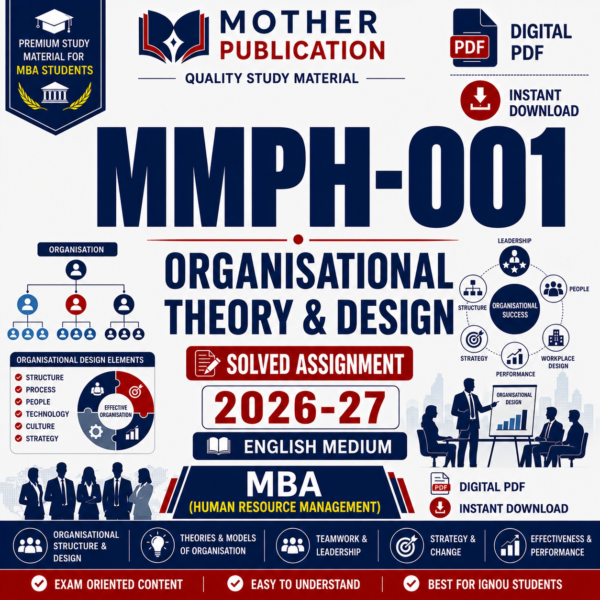
MMPH-001 Solved Assignment 2026-27 in English | MBA (Human Resource Management)
MMPH-001 Solved Assignment 2026-27 in English is prepared for the course MMPH-001: Organisational Theory and Design.
The current 2026–27 assignment is coded MMPH-001/TMA/JULY/2026 and covers All Blocks. The assignment carries 100 marks and is applicable for the July 2026 and January 2027 semesters.
IGNOU officially lists MMPH-001: Organisational Theory and Design as a 4-credit theory course.
MMPH-001 Course Information
| Particular | Details |
|---|---|
| Course Code | MMPH-001 |
| Course Title | Organisational Theory and Design |
| Programme | MBA (Human Resource Management) |
| Programme Code | MBAHM |
| Applicable Programmes | MBA, MBAOL, PGDIHRM, MBAHM |
| Medium | English |
| Session | July 2026 & January 2027 |
| Assignment Code | MMPH-001/TMA/JULY/2026 |
| Coverage | All Blocks |
| Maximum Marks | 100 |
| Format | Digital PDF |
MMPH-001 Assignment Overview
The 2026–27 assignment contains five questions covering important concepts of organisational theory, organisational design and human-resource-related organisational practices.
Major topics include:
- Organisational Effectiveness
- Organisational Efficiency
- Organisational Restructuring
- Functional and Matrix Organisation Structures
- Job Design
- Quality of Work Life
- Job Enrichment
- Job Rotation
- Organisational Conflict
- Conflict Resolution Techniques
MMPH-001 Assignment Questions
Question 1 — Organisational Effectiveness
Define Organisational Effectiveness. Discuss how organisational effectiveness differs from organisational efficiency and explain two major approaches/models used by managers to evaluate the effectiveness of a modern organisation.
Question 2 — Organisational Restructuring
Explain Organisational Restructuring. Discuss why established organisations choose to restructure their organisational designs and outline the key steps involved in the restructuring process.
Question 3 — Functional and Matrix Structures
Explain the difference between a Functional Organisation Structure and a Matrix Organisation Structure.
Also discuss:
- Advantages of Matrix Structure
- Operational challenges
- Coordination
- Dual reporting relationships
- Managerial responsibilities
Question 4 — Job Design and QWL
ABC Ltd. is experiencing high employee turnover and reduced motivation because employees are working in repetitive, monotonous and rigidly designed clerical and technical jobs.
As the Senior HR Manager, prepare an action plan covering:
a) The core purpose of introducing a new job design.
b) Practical implementation of:
- Job Enrichment
- Job Rotation
The objective is to eliminate monotony and improve employee morale and Quality of Work Life.
Question 5 — Organisational Conflict
Explain the statement that moderate organisational conflict can be constructive while extreme conflict can become dysfunctional.
Discuss:
- Inverted U-shaped relationship between conflict and performance
- Constructive conflict
- Dysfunctional conflict
- Conflict resolution
- Three conflict-resolution techniques available to managers
Organisational Effectiveness
Organisational effectiveness refers to the extent to which an organisation achieves its objectives and performs successfully in relation to its environment, stakeholders and available resources.
It should be distinguished from efficiency.
Effectiveness
Focuses mainly on doing the right things and achieving desired organisational objectives.
Efficiency
Focuses mainly on doing things economically and making the best use of available resources.
An organisation may be efficient in using resources but still ineffective if it fails to achieve its important goals.
Organisational Restructuring
Organisational restructuring involves making significant changes to an organisation’s existing structure, roles, reporting relationships, processes or allocation of resources.
Organisations may restructure because of:
- Changes in business strategy
- Technological developments
- Competition
- Cost pressures
- Mergers and acquisitions
- Changes in customer requirements
- Poor organisational performance
- Need for greater flexibility
A restructuring process normally involves analysing the existing structure, identifying problems, developing a new design, communicating changes, implementing the structure and evaluating its effectiveness.
Functional Organisation Structure
A functional organisation groups employees according to specialised functions.
Examples include:
- Finance
- Marketing
- Human Resources
- Operations
- Information Technology
Advantages
- Specialisation
- Clear responsibilities
- Efficient use of expertise
- Easier supervision
- Functional development
Limitations
- Departmental silos
- Communication problems
- Slow cross-functional coordination
- Limited organisational perspective
Matrix Organisation Structure
A Matrix Structure combines functional and project/product dimensions.
An employee may report to both:
- A functional manager
- A project/product manager
Advantages
- Better resource utilisation
- Cross-functional coordination
- Greater flexibility
- Improved project focus
- Sharing of specialised expertise
Challenges
- Dual reporting
- Role conflicts
- Authority conflicts
- Communication complexity
- Greater managerial coordination requirements
Quality of Work Life
Quality of Work Life (QWL) refers to the overall quality of an employee’s working experience.
A poor QWL environment may involve:
- Repetitive work
- Lack of autonomy
- Poor working conditions
- Limited growth opportunities
- Excessive stress
- Lack of recognition
- Weak employee participation
Improving QWL can contribute to higher motivation, job satisfaction and employee retention.
Job Enrichment
Job enrichment means increasing the depth of a job by giving employees greater responsibility, autonomy, decision-making authority and opportunities for achievement.
Examples include:
- Giving employees greater control over their work
- Increasing responsibility
- Allowing participation in decisions
- Providing feedback
- Giving opportunities to use higher-level skills
Job Rotation
Job rotation involves moving employees between different jobs or tasks to provide broader work experience and reduce monotony.
Benefits include:
- Reduced boredom
- Broader skills
- Greater flexibility
- Better understanding of organisational operations
- Improved employee motivation
- Development of multi-skilled employees
Organisational Conflict
Organisational conflict occurs when individuals or groups have incompatible interests, goals, perceptions or expectations.
Conflict is not always harmful.
Moderate Conflict
Moderate levels of conflict can encourage:
- New ideas
- Critical thinking
- Innovation
- Problem solving
- Healthy debate
Excessive Conflict
Very high levels of conflict can cause:
- Stress
- Reduced cooperation
- Poor communication
- Lower productivity
- Employee dissatisfaction
- Dysfunctional behaviour
Inverted U-Shaped Relationship
The relationship between conflict and performance can be represented through an Inverted U-shaped curve.
At very low levels of conflict, performance may be low because there is little stimulation or challenge.
As conflict reaches a moderate level, performance can improve because employees critically evaluate ideas and generate alternatives.
When conflict becomes excessive, performance begins to decline because disagreement, stress and disruption become dominant.
Therefore:
Low Conflict → Low/Moderate Performance
Moderate Conflict → Higher Performance
Excessive Conflict → Lower Performance
Conflict Resolution Techniques
Managers can use several techniques to manage organisational conflict, including:
Negotiation
Parties communicate directly to reach a mutually acceptable solution.
Collaboration
The parties work together to identify the underlying problem and develop a solution satisfying important interests of both sides.
Mediation
A neutral third party helps conflicting parties communicate and reach an agreement.
Other approaches may include accommodation, compromise and avoidance depending on the nature and seriousness of the conflict.
Key Features
- MMPH-001 Organisational Theory and Design
- 2026–27 Session
- July 2026 & January 2027
- English Medium
- All Blocks
- 100 Marks
- Five Assignment Questions
- Organisational Effectiveness
- Organisational Efficiency
- Organisational Restructuring
- Functional Organisation Structure
- Matrix Organisation Structure
- Quality of Work Life
- Job Design
- Job Enrichment
- Job Rotation
- Organisational Conflict
- Inverted U-shaped Conflict Model
- Conflict Resolution
- Digital PDF
WHO CAN USE THIS MMPH-001 PDF?
IGNOU’s current assignment listing shows MMPH-001 for:
- MBA
- MBAOL
- PGDIHRM
- MBAHM
The official IGNOU MBA and MBAHM programme pages also list MMPH-001 as Organisational Theory and Design.
HOW TO GET THIS MMPH-001 PDF
Step 1: Add the Product
Select MMPH-001 Solved Assignment 2026-27 in English and add it to your cart.
Step 2: Complete Payment
Complete the checkout process using the available payment method.
Step 3: Get Digital Access
After successful order processing, digital access is provided through the website’s download system.
Step 4: Download
Download the PDF on your mobile, tablet, laptop or desktop.
Step 5: Prepare
Use the material as a structured academic reference while preparing your MMPH-001 assignment.
FREQUENTLY ASKED QUESTIONS
1. What is MMPH-001?
MMPH-001 is Organisational Theory and Design.
2. What is the MMPH-001 assignment code?
MMPH-001/TMA/JULY/2026.
3. Which programmes are applicable?
MBA, MBAOL, PGDIHRM and MBAHM.
4. What is the medium?
English.
5. How many questions are there?
There are five questions in the 2026–27 assignment.
6. What are the major topics?
Organisational effectiveness, restructuring, organisational structures, job design, QWL, job enrichment, job rotation and organisational conflict.
7. What is the difference between job enrichment and job rotation?
Job enrichment increases the depth and responsibility of a job, whereas job rotation moves employees between different jobs or tasks.
8. What is the Inverted U-shaped conflict relationship?
It explains that moderate conflict may improve performance, while excessive conflict can reduce performance.
9. What is the format?
Digital PDF.
DISCLAIMER
Mother Publication independently prepares this material for educational and reference purposes. Students should understand the concepts and prepare their assignments appropriately. Mother Publication is not affiliated with, endorsed by, or officially associated with IGNOU.
PRODUCT TAGS
MMPH-001, MMPH 001, MMPH001, MMPH-01, MMPH 01, MMPH01, MMPH-1, MMPH 1, MMPH1, MMPH-001 solved assignment 2026-27, MMPH 001 solved assignment 2026-27, MMPH001 solved assignment 2027, MMPH-01 solved assignment 2027, MMPH-1 assignment 2027, MMPH 1 assignment 2027, MMPH001 assignment 2026-27, MMPH-001 assignment 2026-27, MMPH 001 assignment 2026-27, MMPH-001 solved assignment, MMPH 001 solved assignment, MMPH001 solved assignment, MMPH-001 Organisational Theory and Design, Organisational Theory and Design solved assignment, Organisational Theory and Design assignment 2026-27, Organisational Theory and Design assignment 2027, MMPH-001 PDF, MMPH 001 PDF, MMPH001 PDF, MMPH-001 English, MMPH 001 English Medium, MMPH001 English Medium, MMPH-001 2026-27, MMPH 001 2026-27, MMPH001 2027, MMPH-001 July 2026, MMPH-001 January 2027, MMPH-001 July 2026 January 2027, MMPH-001 MBA, MMPH-001 MBAOL, MMPH-001 PGDIHRM, MMPH-001 MBAHM, MBA Human Resource Management assignment, MBAHM assignment 2026-27, MBAHM MMPH-001, PGDIHRM MMPH-001, MBAOL MMPH-001, Organisational Theory and Design MBA assignment, Organisational Theory and Design MBAHM assignment, Organisational Theory and Design MBAOL assignment, Organisational Theory and Design PGDIHRM assignment, MMPH-001 digital PDF, MMPH-001 solved PDF, MMPH-001 assignment PDF, MMPH-001 TMA July 2026, MMPH 001 Organisational Theory and Design 2026-27, Organisational Theory and Design 2026-27 solved assignment, Organisational Effectiveness assignment, Organisational Restructuring assignment, Functional Organisation Structure assignment, Matrix Organisation Structure assignment, Job Design assignment, Job Enrichment assignment, Job Rotation assignment, Quality of Work Life assignment, Organisational Conflict assignment, Conflict Resolution assignment, MMPH001 HR assignment, MMPH001 organisational design, MMPH001 organisational effectiveness