
Download IGNOU Solved
Assignments 2026–27 PDF
Get the latest IGNOU solved assignment PDFs for Undergraduate, Postgraduate, Diploma, PG Diploma and Certificate programmes. Available in Hindi Medium and English Medium. Instant digital download updated for the latest session.
Browse Assignments by Category
Find your IGNOU programme category and explore the latest solved assignments for 2026–27 session.
Latest IGNOU Solved Assignments 2026–27
Explore newly uploaded, 100% verified solved assignment PDFs for the current session.
- Sale!
 CWHM - Certificate in Water Harvesting & Management
ONR-002 Solved Assignment July 2026 & January 2027 in Hindi | जल विज्ञान के मूल तत्व
₹60Original price was: ₹60.₹29Current price is: ₹29. - Sale!MASO - MA Sociology
MPSE-008 Solved Assignment 2026-27 in Hindi | भारत में राज्य की राजनीति
₹100Original price was: ₹100.₹49Current price is: ₹49. - Sale!MASO - MA Sociology
MPSE-007 Solved Assignment 2026-27 in Hindi | भारत में सामाजिक आंदोलन और राजनीति
₹100Original price was: ₹100.₹49Current price is: ₹49. - Sale!MAPS - MA Political Science
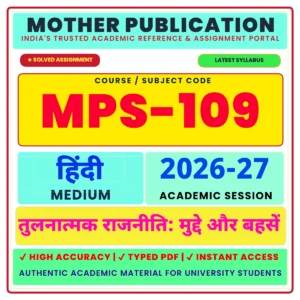
MPS-109 Solved Assignment 2026-27 in Hindi | तुलनात्मक राजनीति: मुद्दे और बहसें
₹100Original price was: ₹100.₹49Current price is: ₹49. - Sale!MAPS - MA Political Science
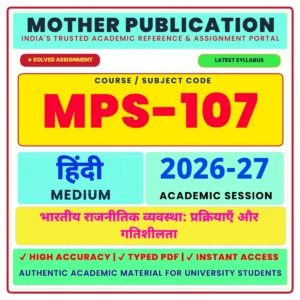
MPS-107 Solved Assignment 2026-27 in Hindi | भारतीय राजनीतिक व्यवस्था: प्रक्रियाएँ और गतिशीलता
₹100Original price was: ₹100.₹49Current price is: ₹49. - Sale!MAPS - MA Political Science
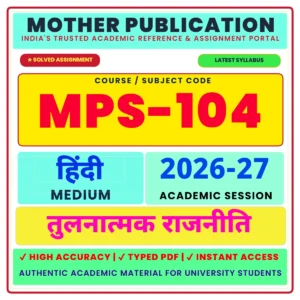
MPS-104 Solved Assignment 2026-27 in Hindi | तुलनात्मक राजनीति
₹100Original price was: ₹100.₹49Current price is: ₹49. - Sale!MAPS - MA Political Science
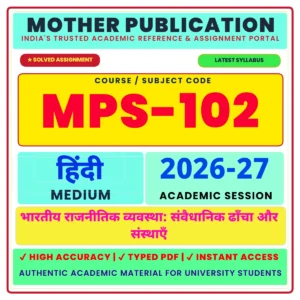
MPS-102 Solved Assignment 2026-27 in Hindi | भारतीय राजनीतिक व्यवस्था: संवैधानिक ढाँचा और संस्थाएँ
₹100Original price was: ₹100.₹49Current price is: ₹49. - Sale!PGDIHRM - Post Graduate Diploma In Human Resource Management
MMPH-007 Solved Assignment 2026-27 in Hindi | प्रतिपूर्ति और पुरस्कार प्रबंधन
₹150Original price was: ₹150.₹69Current price is: ₹69.
Latest IGNOU News & Study Guides
IGNOU Assignment Last Date Extended to 31 October 2026 for December TEE
IGNOU ASSIGNMENT UPDATE IGNOU Assignment Last Date Extended to 31 October 2026 IGNOU has extended the...
How to Write IGNOU Assignments for 2026 and 2027 Sessions
IGNOU Student Guide How to Write IGNOU Assignments for 2026 and 2027 Sessions Learn the correct...
ignou-assignment-question-paper-download
IGNOU STUDENT GUIDE IGNOU Assignment Question Paper 2026-27: Download Course-Wise PDFs Find IGNOU assignment question papers...
IGNOU PG Certificate Solved Assignment 2026-27: Complete Subject Index & Download Guide
Home › Blog › IGNOU PG Certificate Solved Assignment 2026-27 🎓 IGNOU Student Guide • Academic...
IGNOU Certificate Solved Assignment 2026-27: The Ultimate Masterclass & All 53 Programme Solutions
📚 IGNOU Academic Session 2026-27 • ⏱️ 14 Min Masterclass Read • ✍️ Mother Publication Academic...
IGNOU Diploma Solved Assignment 2026-27: Programme-Wise PDF Download, Submission Last Dates & Complete Academic Guide
Home → Solved Assignments → 2026-27 → Diploma Academic Session 2026-27 • Official Comprehensive Guide IGNOU...
Frequently Asked Questions
Welcome to Mother Publication. Below are answers to the most frequently asked questions by IGNOU students regarding our updated 2026–27 IGNOU solved assignments, instant PDF downloads, course codes, and assignment submission guidelines.
What are IGNOU solved assignments?
IGNOU solved assignments are reference solutions prepared by experienced academic experts to assist IGNOU students in completing their mandatory continuous evaluation coursework. Every Indira Gandhi National Open University degree, diploma, and certificate course requires assignment submissions that carry thirty percent weightage in the final grade card. At Mother Publication, our IGNOU Solved Assignments provide accurate, well-researched, and structured answers formatted according to official university guidelines and syllabus requirements. These solved assignments serve as an educational study guide, helping students understand complex concepts, structure long-form answers properly, and prepare for term-end examinations effectively. By reviewing our high-quality IGNOU study material, students gain clarity on question patterns, marking schemes, and subject-specific terminology, ensuring a smooth academic journey and stress-free IGNOU assignment submission.
Are these solved assignments updated for the latest 2026–27 session?
Yes, all solutions provided on Mother Publication are strictly updated for the current IGNOU Assignment 2026–27 academic session. IGNOU updates its assignment question papers annually for July and January admission cycles. Our expert academic team meticulously verifies every question paper published on the official IGNOU web portal before drafting verified solutions. When you purchase an IGNOU Assignment PDF from us, you are guaranteed to receive the Latest IGNOU Assignments matching the exact session, semester, or year of your re-registration. Submitting outdated assignments can result in rejection or zero marks by university evaluators. Therefore, Mother Publication ensures complete alignment with current session guidelines, latest session question booklets, and official submission deadlines, giving IGNOU students complete confidence in their submissions.
Can I download solved assignments instantly after payment?
Yes, you can download IGNOU assignment PDF files immediately after completing your online purchase. Mother Publication uses an automated, instant digital delivery system designed specifically for the convenience of IGNOU students. Once your payment is successfully verified through our secure payment gateway, an instant download button will appear on your order confirmation screen. Additionally, an automated email containing the direct download link for your purchased IGNOU Solved Assignments will be sent instantly to your registered email address. This ensures zero waiting time, allowing you to access your reference materials, start writing your handwritten assignment sheets, and meet your study center deadlines without any delay.
Are assignments available in both English Medium and Hindi Medium?
Yes, Mother Publication offers IGNOU Solved Assignments in both English Medium and Hindi Medium to cater to the diverse language preferences of IGNOU students across India. Whether you are pursuing Bachelor Degree programmes like BAG, BCOMG, BSCG, Honours courses, or Master Degree programmes like MEG, MHD, MPS, MAH, or MBA, we maintain a comprehensive collection of solutions in both mediums. Our subject specialists write answers in clear, grammatically correct language appropriate for each medium. Before adding a product to your cart, simply select your preferred medium from the product page options to download IGNOU assignment PDF in the exact language you need for your IGNOU assignment submission.
How do I find my IGNOU course code?
Finding your correct IGNOU Course Code is very simple. Your course code (such as BSOC 131, BEGAE 182, or IBO 01) represents the specific subject paper you are enrolled in for your programme. You can easily find your course codes printed on your official IGNOU admission status page, student portal dashboard, identity card, or course registration slip. Alternatively, you can search for your subject title on Mother Publication using our search bar, and the corresponding IGNOU Course Code will be displayed alongside the subject name. Always double-check your course code and subject title against your official IGNOU study material before downloading to ensure you obtain the exact solved assignment needed for your session.
Can I submit handwritten assignments using these solved assignments?
IGNOU rules explicitly state that students must submit handwritten assignments at their designated study center or upload scanned copies of handwritten pages to the official regional center portal. The IGNOU Solved Assignments provided by Mother Publication are intended as reference study guides and exemplar solutions. You should carefully read the provided solutions, understand the core concepts, and write the answers in your own handwriting on standard A4 size lined or plain sheets. Copying directly while understanding the content ensures that your handwriting remains authentic, personalized, and fully compliant with university guidelines. Utilizing our reference material helps you organize your handwritten pages neatly, follow correct formatting, and complete your IGNOU assignment submission effortlessly.
Will these solved assignments help me score better marks?
Yes, using Mother Publication solved assignments significantly enhances your chances of securing higher marks in continuous internal evaluations. Evaluators at IGNOU study centers look for well-structured answers, precise introduction and conclusion paragraphs, relevant sub-headings, accurate data, and proper word-count adherence. Our experienced academic authors prepare every IGNOU Assignment PDF keeping these official marking rubrics in mind. By studying our reference solutions, IGNOU students learn how to structure complex answers logically, present key arguments effectively, and cover all sub-questions comprehensively. This high-standard approach elevates the academic quality of your handwritten assignments and provides excellent preparation for your upcoming term-end examinations.
How do I download my assignment PDF after purchase?
Downloading your purchased IGNOU Assignment PDF from Mother Publication is quick and straightforward. Immediately after completing your payment via UPI, debit card, credit card, or net banking, you will be redirected to the order summary page featuring a prominent "Download PDF" button. Simply click this button to save the file to your smartphone, tablet, or computer. Simultaneously, our automated system dispatches an email receipt containing a permanent download link to your registered email address. You can also log into your Mother Publication user account at any time to access your past order history and re-download your purchased IGNOU Solved Assignments whenever required.
Do you provide solved assignments for all IGNOU programmes?
Mother Publication strives to maintain the most extensive catalog of Latest IGNOU Assignments available online. We cover almost all major undergraduate, postgraduate, diploma, and certificate programmes offered by Indira Gandhi National Open University. This includes popular courses such as BA, BCOM, BSC, MA, MCOM, MBA, MSW, MCA, BCA, BLIS, MLIS, BED, and various specialized PG Diplomas. Our dedicated research team continuously updates our digital library whenever new course codes are introduced by the university. Whether you need core discipline papers, elective subjects, or ability enhancement compulsory courses (AECC), Mother Publication is your one-stop destination for complete IGNOU study material.
What should I do if I cannot find my subject or course?
If you cannot find your specific IGNOU Course Code or subject title using the search bar on Mother Publication, do not worry. University curricula frequently introduce new elective subjects or revised course codes. If a particular subject is not listed on our website, you can immediately contact our dedicated student support team via WhatsApp or email provided on our contact page. Share your subject name, course code, and assignment question paper PDF with us. Our academic specialists will prioritize drafting authentic solutions for your subject and notify you as soon as the updated IGNOU Assignment PDF is prepared and uploaded to our portal.
How often are solved assignments updated?
Our academic team updates all content on Mother Publication continuously throughout the academic year. As soon as Indira Gandhi National Open University releases fresh assignment question papers for the July or January admission cycles, our subject matter experts begin reviewing and solving them immediately. We strictly archive previous year files to ensure that students never accidentally download outdated material. When you search for an IGNOU Assignment 2026–27 on our platform, you can be completely confident that you are getting the newest edition with 100% accurate, up-to-date answers aligned with the current syllabus and examination guidelines.
Can I use these solved assignments for reference and self-study?
Absolutely. In fact, self-study and academic reference are the primary intended uses of our IGNOU Solved Assignments. Distance learning students often face challenges due to delayed physical textbook delivery or complex study material. Our solved assignment PDFs act as comprehensive revision notes and model answer keys. By studying these materials, IGNOU students can quickly grasp core subject concepts, learn effective answer-writing techniques, memorize important definitions, and gain insights into likely examination questions. Using Mother Publication solutions for self-study saves valuable time, boosts conceptual understanding, and builds overall academic confidence for both assignment submission and term-end theory exams.
What payment methods are accepted?
Mother Publication offers a smooth, seamless, and highly secure checkout experience for all IGNOU students across India. We support all popular Indian digital payment channels through SSL-encrypted payment gateways. You can pay conveniently using Instant UPI apps such as Google Pay, PhonePe, Paytm, and BHIM. We also accept all major Debit Cards, Credit Cards (Visa, Mastercard, RuPay, Maestro), Net Banking across 50+ Indian banks, and popular mobile wallets. All transactions are processed instantly, enabling our system to grant immediate access to download IGNOU assignment PDF files without manual intervention or billing delays.
Is my PDF download available immediately after successful payment?
Yes, your PDF download is available instantly upon successful completion of your payment. At Mother Publication, we understand that students often operate under tight IGNOU assignment submission deadlines. Therefore, our platform uses automated cloud delivery triggers that generate your download link the exact second your payment authorization goes through. There is no manual approval process or waiting period required. You can immediately save the IGNOU Assignment PDF to your phone or laptop and begin writing your assignments right away. In case of any network glitch, your download link remains accessible in your email invoice and account dashboard.
Why do thousands of IGNOU students choose Mother Publication?
Thousands of IGNOU students trust Mother Publication as their preferred academic companion because of our uncompromised commitment to quality, accuracy, and student success. Unlike generic websites that offer copy-pasted or AI-generated junk, our solutions are meticulously crafted by subject experts with deep knowledge of IGNOU evaluation standards. We offer 100% updated IGNOU Assignment 2026–27 solutions, dual-medium support (English and Hindi), transparent pricing, instant PDF downloads, and responsive WhatsApp customer care. With thousands of positive reviews and a track record of helping students secure top grades, Mother Publication remains India's most trusted portal for authentic IGNOU study material and solved assignments.
Why Choose Mother Publication?
Mother Publication helps IGNOU students with professionally prepared IGNOU Solved Assignments for the Latest Session 2026–27, making assignment preparation faster, easier, and more reliable.
Latest Session Assignments
Updated IGNOU Assignment PDF solutions prepared for the latest IGNOU academic session.
English & Hindi Medium
Assignments available in both English Medium and Hindi Medium for eligible programmes.
Instant PDF Download
Download your solved assignments immediately after completing your order.
Well-Structured Answers
Professionally organised answers with clear formatting for better readability.
Wide Programme Coverage
Assignments available for Undergraduate, Postgraduate, Diploma and Certificate programmes.
Trusted Student Support
Helping thousands of IGNOU students access assignment solutions with confidence from Mother Publication.
Supporting IGNOU Students Across India
Our goal is to provide updated, organised and easily accessible solved assignments so students can prepare with confidence for the latest IGNOU session.
Ready to Download Your Assignment?
Browse the latest solved assignments organised programme-wise and download instantly.
Browse Solved AssignmentsStudent Testimonials
See what IGNOU students say about their experience with Mother Publication and our solved assignment PDFs.
Rahul Sharma
BCA
"The solved assignments were easy to understand and perfectly organised. Download was instant and the content helped me complete my assignment confidently."
Priya Verma
MCOM
"Excellent quality assignment PDFs. The answers were well structured and saved me a lot of preparation time."
Amit Kumar
BAG
"Very useful solved assignments. Instant delivery and clear formatting made assignment preparation much easier."
Neha Singh
MBA
"Professional content and simple language. Highly recommended for IGNOU students looking for updated assignments."
Rohit Kumar
MA English
"Latest session assignments with neat formatting. Great experience purchasing from Mother Publication."
Pooja Rani
BCOM
"Fast download, quality answers and easy navigation. I found my assignment within minutes."
3000+
Solved Assignment PDFs
10000+
Happy Students
Latest
2026–27 Session
Instant
PDF Download
Ready to Download Your Assignment?
Browse the latest IGNOU solved assignments for Undergraduate, Postgraduate, Diploma and Certificate programmes.
Browse Solved Assignments