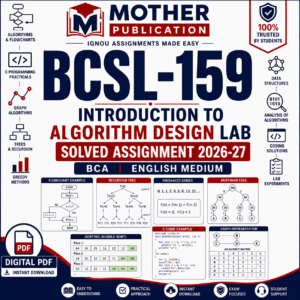
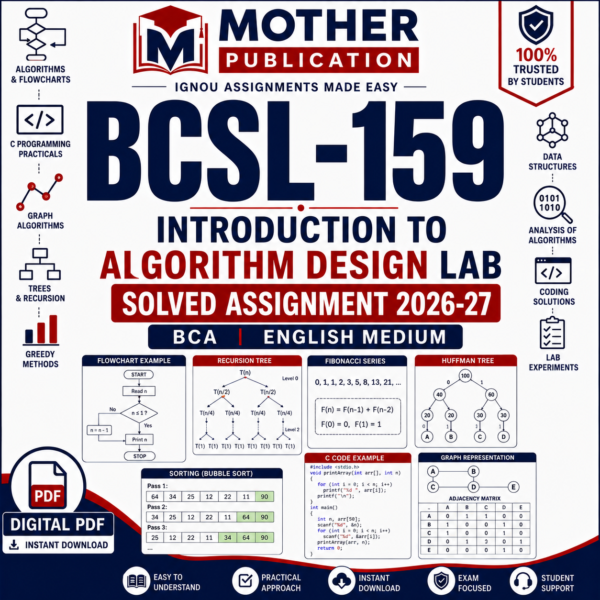
BCSL-159 Solved Assignment 2026-27 in English | Bachelor of Computer Applications
BCSL-159 Solved Assignment 2026-27 in English is designed for students of the Bachelor of Computer Applications (BCA) studying BCSL-159: Introduction to Algorithm Design Lab.
The supplied 2026-27 assignment contains 8 questions of 10 marks each, carrying 80 marks, with the remaining 20 marks allocated to Viva Voce. The assignment specifically requires students to write the programs in the C language.
BCSL-159 Course Information
| Particular | Details |
|---|---|
| Course Code | BCSL-159 |
| Course Title | Introduction to Algorithm Design Lab |
| Programme | Bachelor of Computer Applications |
| Programme Code | BCA_NEW / BCA_NEWOL |
| Semester | V |
| Medium | English |
| Session | 2026-27 |
| Assignment Code | BCA_NEW/BCAOL(V)L-159/Assign/2026-27 |
| Maximum Marks | 100 |
| Number of Questions | 8 |
| Marks per Question | 10 |
| Assignment Marks | 80 |
| Viva Voce | 20 |
| Format | Digital PDF |
The assignment gives the last dates as 31 October 2026 for the July 2026 Session and 30 April 2027 for the January 2027 Session.
BCSL-159 Topics Covered
The assignment covers important Algorithm Design and C programming concepts including:
- Recursion
- Fibonacci Sequence
- Tower of Hanoi
- Time Complexity
- Polynomial Evaluation
- Horner’s Method
- Matrix Multiplication
- Nested Loops
- Fractional Knapsack
- Greedy Algorithms
- Huffman Coding
- Huffman Tree
- Data Compression
- Divide-and-Conquer
- Karatsuba Multiplication
- Graph Algorithms
- Depth First Search
- Cycle Detection
- Complexity Analysis
BCSL-159 Assignment Questions
Q1. Fibonacci Sequence Using Recursion
Write a C program to generate the Fibonacci sequence using recursion.
The solution explains the recursive relation:
F(n) = F(n − 1) + F(n − 2)
with base conditions:
F(0) = 0
F(1) = 1
The supplied solved material also analyses the recursive algorithm as approximately O(2ⁿ) time complexity with O(n) auxiliary stack space.
Q2. Tower of Hanoi
Write a recursive C program to solve the Tower of Hanoi problem and analyse its time complexity.
The problem uses three rods:
- Source
- Auxiliary
- Destination
The recursive solution follows:
T(n) = 2T(n−1) + 1
giving:
T(n) = 2ⁿ − 1
Therefore, the time complexity is O(2ⁿ) and the recursive stack requires O(n) auxiliary space.
Q3. Polynomial Evaluation Using Horner’s Method
Write a C program to evaluate a polynomial efficiently using Horner’s method.
For a polynomial:
P(x) = aₙxⁿ + aₙ₋₁xⁿ⁻¹ + … + a₁x + a₀
Horner’s method converts it into nested form:
P(x) = (…((aₙx + aₙ₋₁)x + aₙ₋₂)x + … + a₁)x + a₀
This method evaluates a polynomial in O(n) time while avoiding repeated power calculations.
Q4. Matrix Multiplication
Write a C program to multiply two n×n matrices using nested loops.
The program uses three nested loops:
- Select the row of the first matrix.
- Select the column of the second matrix.
- Calculate the sum of products for each resultant element.
The core calculation is:
c[i][j] = c[i][j] + a[i][k] * b[k][j]
The resulting algorithm has O(n³) time complexity and O(n²) space requirement for the matrices.
Q5. Fractional Knapsack
Write a C program to solve the Fractional Knapsack problem and maximise total profit using a greedy approach.
The algorithm:
- Reads item profits and weights.
- Calculates profit-to-weight ratio.
- Sorts items in decreasing ratio order.
- Selects complete items whenever possible.
- Takes a fraction of the next item when necessary.
- Calculates maximum achievable profit.
The supplied solution uses a simple sorting implementation with O(n²) time complexity.
Q6. Huffman Tree and Huffman Codes
Write a C program to construct a Huffman tree and generate the corresponding Huffman codes.
The algorithm repeatedly:
- Creates a leaf node for each character.
- Selects the two nodes having the smallest frequencies.
- Combines them into a new node.
- Reinserts the new node.
- Repeats until a single root remains.
- Traverses the tree recursively.
- Assigns
0to the left edge and1to the right edge.
Huffman coding provides lossless data compression by assigning shorter codes to more frequent characters.
Q7. Karatsuba Multiplication
Write a recursive C program to perform large integer multiplication using the Karatsuba multiplication algorithm.
This question focuses on the divide-and-conquer paradigm and recursive multiplication of large integers. The supplied solved assignment includes the mathematical formulation and recursive C implementation.
Q8. Cycle Detection in an Undirected Graph
Write a C program to detect a cycle in an undirected graph.
The supplied solution uses Depth First Search (DFS) with parent tracking.
The algorithm:
- Represents the graph using an adjacency matrix.
- Marks all vertices as unvisited.
- Starts DFS from every unvisited vertex.
- Marks the current vertex as visited.
- Recursively visits unvisited adjacent vertices.
- If an already visited adjacent vertex is not the parent, a cycle exists.
The adjacency-matrix implementation has O(V²) time complexity.
What This BCSL-159 Solved Assignment Includes
The BCSL-159 Solved Assignment 2026-27 in English covers all 8 practical programming questions from the supplied assignment.
It includes:
- Fibonacci using recursion
- Tower of Hanoi
- Recursion and complexity analysis
- Horner’s polynomial evaluation
- Matrix multiplication
- Fractional Knapsack
- Greedy algorithms
- Huffman tree
- Huffman coding
- Karatsuba multiplication
- Divide-and-conquer
- Graph cycle detection
- DFS
- C programs
- Algorithms
- Explanations
- Sample outputs
- Complexity analysis
- Conclusions
Key Features
- BCSL-159 Introduction to Algorithm Design Lab
- Solved Assignment 2026-27
- English Medium
- BCA Semester V
- Complete 8-question coverage
- C programming
- Recursion
- Divide-and-conquer algorithms
- Greedy algorithms
- Graph algorithms
- Huffman coding
- Karatsuba multiplication
- Matrix multiplication
- Complexity analysis
- Sample outputs
- Digital PDF format
- Instant Download
Important Assignment Information
Course Code: BCSL-159
Course Title: Introduction to Algorithm Design Lab
Assignment Code: BCA_NEW/BCAOL(V)L-159/Assign/2026-27
Maximum Marks: 100
Questions: 8
Marks per Question: 10
Assignment Marks: 80
Viva Voce: 20
July 2026 Submission: 31 October 2026
January 2027 Submission: 30 April 2027
Frequently Asked Questions
1. What is BCSL-159?
BCSL-159 is Introduction to Algorithm Design Lab.
2. Which programme is BCSL-159 for?
It is for students of the Bachelor of Computer Applications (BCA) programme.
3. What is the BCSL-159 assignment code?
BCA_NEW/BCAOL(V)L-159/Assign/2026-27.
4. How many questions are in BCSL-159?
There are 8 questions, each carrying 10 marks.
5. What is the maximum mark?
The assignment has a maximum of 100 marks, including 80 assignment marks and 20 viva voce marks.
6. Which programming language is required?
The assignment specifically instructs students to write all programs in C.
7. Which algorithms are covered?
The assignment covers Fibonacci recursion, Tower of Hanoi, Horner’s method, matrix multiplication, Fractional Knapsack, Huffman coding, Karatsuba multiplication and DFS-based cycle detection.
8. What is the time complexity of recursive Fibonacci?
The supplied solution gives approximately O(2ⁿ) time complexity and O(n) auxiliary space.
9. What is the time complexity of Tower of Hanoi?
The recursive Tower of Hanoi algorithm has O(2ⁿ) time complexity.
10. What are the submission dates?
The supplied assignment states 31 October 2026 for July 2026 and 30 April 2027 for January 2027.
Disclaimer
This material is independently prepared by Mother Publication for educational and reference purposes. Students should read, understand and appropriately use the material while preparing their assignments. Mother Publication is not affiliated with, endorsed by, or officially associated with IGNOU.
PRODUCT TAGS
BCSL-159, BCSL 159, BCSL159, BCSL-15, BCSL 15, BCSL15, BCSL-159 Solved Assignment 2026-27, BCSL 159 Solved Assignment 2026-27, BCSL159 Solved Assignment 2026-27, BCSL-15 Solved Assignment 2026-27, BCSL 15 Solved Assignment 2026-27, BCSL15 Solved Assignment 2026-27, BCSL-159 Solved Assignment 2027, BCSL 159 Solved Assignment 2027, BCSL159 Solved Assignment 2027, BCSL-15 Assignment 2027, BCSL 15 Assignment 2027, BCSL15 Assignment 2027, BCSL-159 Introduction to Algorithm Design Lab, BCSL 159 Introduction to Algorithm Design Lab, BCSL159 Introduction to Algorithm Design Lab, Introduction to Algorithm Design Lab Assignment 2026-27, Introduction to Algorithm Design Lab Solved Assignment, Introduction to Algorithm Design Lab PDF, BCSL-159 Assignment PDF, BCSL 159 Assignment PDF, BCSL159 Assignment PDF, BCA BCSL-159, BCA Algorithm Design Lab, BCA Solved Assignment 2026-27, BCA Assignment PDF 2026-27, Bachelor of Computer Applications Assignment, BCSL-159 English Medium, BCSL 159 English Medium, BCSL159 English Medium, BCSL-159 2026-27, BCSL 159 2026-27, BCSL159 2027, BCSL-159 Solved PDF, BCSL-159 Assignment Questions, BCSL-159 Question Paper, BCSL-159 Solution, BCSL-159 Answers, BCSL-159 C Programming, BCSL-159 Algorithms, BCSL-159 Algorithm Design, BCSL-159 Recursion, BCSL-159 Fibonacci, BCSL-159 Tower of Hanoi, BCSL-159 Horner Method, BCSL-159 Matrix Multiplication, BCSL-159 Fractional Knapsack, BCSL-159 Greedy Algorithm, BCSL-159 Huffman Coding, BCSL-159 Huffman Tree, BCSL-159 Karatsuba Multiplication, BCSL-159 Divide and Conquer, BCSL-159 Graph Algorithm, BCSL-159 DFS, BCSL-159 Cycle Detection, BCSL-159 Time Complexity, BCSL-159 2026-27 PDF