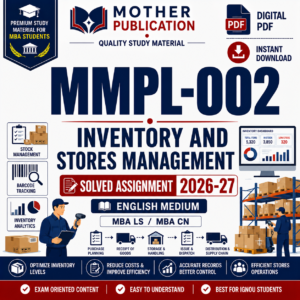
MMPL-001 Solved Assignment 2026-27 in English | MBA
MMPL-001 Solved Assignment 2026-27 in English is prepared for learners studying Principles of Engineering Management and Economics under the applicable IGNOU MBA programmes.
The uploaded assignment identifies MMPL-001 as Principles of Engineering Management and Economics, with assignment code MMPL-001/TMA/JUL/2026 and All Blocks coverage. Students are instructed to attempt all questions. The assignment specifies 31 October 2026 as the last date for the July 2026 session and 30 April 2027 for the January 2027 session.
IGNOU’s current assignment listing identifies MBALS and MBACN as the programmes for MMPL-001, in English, for July 2026 and January 2027, with 100 maximum marks.
IGNOU’s course information describes MMPL-001 as a 4-credit theory course dealing with engineering management and economics, including management concepts, economics for engineers, organisational aspects, managerial control and project management.
MMPL-001 Course Information
| Particular | Details |
|---|---|
| Course Code | MMPL-001 |
| Course Title | Principles of Engineering Management and Economics |
| Programme Codes | MBALS, MBACN |
| Programme | MBA (Logistics & Supply Chain Management) / MBA (Construction Management) |
| Degree | Master of Business Administration |
| Medium | English |
| Session | 2026-27 |
| Assignment Code | MMPL-001/TMA/JUL/2026 |
| Coverage | All Blocks |
| Maximum Marks | 100 |
| Credits | 4 |
| Course Type | Theory |
IGNOU’s official programme information identifies MMPL-001 as a 4-credit course, while the current assignment listing confirms the programme codes, English medium and 100 marks.
MMPL-001 Solved Assignment 2026-27 Overview
MMPL-001 Solved Assignment 2026-27 in English covers important principles of engineering management, economics and project management.
The current assignment contains five main questions, with each question divided into parts (a) and (b). The topics include management approaches, systems and behavioural management, elasticity of demand, time value of money, NPV and IRR, PERT and CPM, float and critical path analysis, value engineering, and Theory X and Theory Y.
MMPL-001 Assignment Questions
Question 1
The first question covers two major management areas:
(a) Taylor’s Scientific Management and the Human Relations approach, including a critical comparison of their treatment of workers.
(b) Integration of the Systems Approach with behavioural insights for managing high-stress engineering projects.
The solved material explains that Taylor focused on standardisation, specialisation, scientific methods and productivity, while the Human Relations approach emphasises communication, teamwork, leadership, recognition and employee satisfaction.
The second part explains how engineering managers can combine systematic planning, scheduling, risk management and resource optimisation with communication, motivation, teamwork and employee well-being.
Question 2 — Engineering Economics
(a) Price Elasticity of Demand
The assignment asks students to define Price Elasticity of Demand and explain the difference between elastic and inelastic demand in pricing a new engineering component.
The solved material defines price elasticity as the ratio between the percentage change in quantity demanded and the percentage change in price.
It explains that:
- Elastic demand: quantity demanded changes significantly with price.
- Inelastic demand: quantity demanded changes relatively little with price.
- Highly elastic engineering products may require competitive or penetration pricing.
- Specialised products with limited substitutes may support relatively higher pricing.
(b) Cross Elasticity of Demand
The second part deals with Cross Elasticity of Demand and its practical importance for a manufacturing firm producing complementary products and close substitutes.
This helps firms understand relationships between products, competitor actions, pricing decisions and production planning.
Question 3 — Time Value of Money and Investment Appraisal
(a) Time Value of Money
The assignment asks why Time Value of Money (TVM) is important when evaluating long-term engineering investments.
The solved material explains that money available today has greater economic value than the same nominal amount received later because of investment opportunities, inflation and risk.
TVM is particularly important for engineering projects because projects such as power plants, factories, highways and manufacturing facilities generally involve large initial investments and benefits spread over several years.
(b) NPV and IRR
The assignment asks students to compare:
- Net Present Value (NPV)
- Internal Rate of Return (IRR)
and identify situations where they may produce conflicting project rankings.
The solved material concludes that when NPV and IRR conflict, NPV is generally preferred, especially for mutually exclusive projects and complex cash-flow patterns, because it directly measures the increase in organisational wealth.
Question 4 — PERT, CPM and Project Scheduling
(a) PERT vs CPM
The assignment asks students to differentiate PERT and CPM on the basis of:
- Event vs Activity orientation
- Probabilistic vs Deterministic time estimates
- Application areas
The solved material explains:
| PERT | CPM |
|---|---|
| Event-oriented | Activity-oriented |
| Probabilistic | Deterministic |
| Uses optimistic, most likely and pessimistic estimates | Uses relatively fixed activity durations |
| Suitable for uncertain projects | Suitable for predictable projects |
| Common in R&D, innovation and uncertain environments | Common in construction, manufacturing and infrastructure |
(b) Total Float, Free Float and Critical Path
The assignment also asks about Total Float, Free Float and the importance of the Critical Path in resource levelling and project crashing.
The solved material explains that:
- Total Float is the maximum delay possible without delaying overall project completion.
- Free Float is the delay possible without affecting the earliest start of the succeeding activity.
- The Critical Path consists of activities with zero total float.
- Resources can be shifted from non-critical activities to critical activities.
- Project crashing should focus on critical-path activities.
Question 5 — Value Engineering and Motivation
(a) Value Engineering
The assignment asks students to define Value Engineering (VE), explain the phases of the Value Engineering Job Plan and distinguish VE from routine cost reduction.
The solved material identifies six major phases:
- Information Phase
- Function Analysis Phase
- Creative Phase
- Evaluation Phase
- Development Phase
- Presentation and Implementation Phase
Value Engineering differs from ordinary cost reduction because it seeks to improve function, quality, reliability and value rather than simply reducing expenditure. It considers life-cycle cost and customer requirements.
Theory X and Theory Y
(b) Human Motivation and Organisational Structure
The assignment asks students to contrast Theory X and Theory Y and explain how these assumptions influence organisational structure in complex technical projects.
The solved material explains:
Theory X
Theory X assumes employees generally avoid work and responsibility and therefore require:
- Close supervision
- Centralised decision-making
- Rules and discipline
- External control
- Strong managerial direction
Theory Y
Theory Y assumes employees can demonstrate:
- Self-direction
- Responsibility
- Creativity
- Problem-solving
- Teamwork
- Participation
- Personal development
For highly complex technical projects, the solved material considers Theory Y more suitable because matrix and project-based structures encourage collaboration, flexibility, empowerment and rapid decision-making.
Major Topics Covered in MMPL-001
Management Thought and Human Behaviour
The assignment covers Scientific Management, Human Relations and Systems Approach, along with the importance of human behaviour, motivation, communication and teamwork in engineering management.
Engineering Economics
Important economic concepts include:
- Price Elasticity of Demand
- Cross Elasticity of Demand
- Time Value of Money
- NPV
- IRR
- Investment appraisal
- Pricing decisions
Project Management
The assignment covers:
- PERT
- CPM
- Total Float
- Free Float
- Critical Path
- Resource Levelling
- Project Crashing
Value Engineering
The assignment discusses functional analysis, creativity, evaluation, development and implementation of value-engineering proposals.
Organisational Behaviour
Theory X and Theory Y are used to explain how assumptions about employee motivation influence management style and organisational structure.
KEY FEATURES
- MMPL-001 Principles of Engineering Management and Economics
- Solved Assignment 2026-27
- English Medium
- Applicable to MBALS and MBACN
- July 2026 + January 2027 cycle
- Assignment Code: MMPL-001/TMA/JUL/2026
- All Blocks coverage
- 100 marks
- 4 credits
- Complete five-question coverage
- Structured reference answers
- Digital PDF
- Instant Download
- Mobile-friendly PDF
- Useful for academic preparation and reference
WHO CAN USE MMPL-001?
MMPL-001 is applicable to the following IGNOU programmes:
- MBALS — MBA (Logistics & Supply Chain Management)
- MBACN — MBA (Construction Management)
IGNOU’s current assignment page specifically lists MBALS, MBACN for MMPL-001 in English for July 2026 and January 2027.
HOW TO GET MMPL-001 SOLVED ASSIGNMENT PDF
Step 1: Select the Product
Select MMPL-001 Solved Assignment 2026-27 in English.
Step 2: Verify Your Course
Confirm:
MMPL-001 — Principles of Engineering Management and Economics
Also verify your programme, session and English medium.
Step 3: Complete Checkout
Add the product to the cart and complete the available payment process.
Step 4: Access the Digital PDF
After successful payment, access the digital product through the website’s delivery system.
Step 5: Download and Prepare
Download the PDF and use the structured answers for academic preparation and reference.
HELPFUL RESOURCES
Official IGNOU Assignment Page:
IGNOU Current Assignments
Official IGNOU MMPL-001 Course Information:
IGNOU MMPL-001 Course Page
FREQUENTLY ASKED QUESTIONS
1. What is MMPL-001?
MMPL-001 is Principles of Engineering Management and Economics. It is a 4-credit theory course.
2. What is the assignment code?
The current assignment code is MMPL-001/TMA/JUL/2026.
3. Which programmes include MMPL-001?
The current IGNOU assignment listing identifies MBALS and MBACN.
4. What is the course title?
Principles of Engineering Management and Economics.
5. What is the medium?
The current assignment is available in English.
6. What is the maximum marks?
The current IGNOU assignment listing shows 100 marks.
7. How many credits is MMPL-001?
MMPL-001 carries 4 credits.
8. How many questions are included?
The assignment contains five main questions, each containing parts (a) and (b), and students are instructed to attempt all questions.
9. What topics are covered?
Major topics include management theories, behavioural management, elasticity of demand, TVM, NPV, IRR, PERT, CPM, float analysis, critical path, value engineering and Theory X & Theory Y.
10. What is the July 2026 submission date?
The assignment states 31 October 2026 for the July 2026 session.
11. What is the January 2027 submission date?
The assignment states 30 April 2027 for the January 2027 session.
DISCLAIMER
Mother Publication independently prepares this material for educational and reference purposes. Students should read, understand and appropriately use the material while preparing their assignments. Mother Publication is not affiliated with, endorsed by, or officially associated with IGNOU.
PRODUCT TAGS
MMPL-001, MMPL 001, MMPL001, MMPL-01, MMPL 01, MMPL01, MMPL-1, MMPL 1, MMPL1, MMPL-001 Solved Assignment 2026-27, MMPL 001 Solved Assignment 2026-27, MMPL001 Solved Assignment 2027, MMPL-1 Solved Assignment 2027, MMPL 1 Assignment 2027, MMPL1 Solved Assignment 2026-27, MMPL-001 Assignment 2026-27, MMPL-001 Solved Assignment 2027, MMPL-001 English Assignment, MMPL-001 Assignment PDF, MMPL-001 Solved PDF, Principles of Engineering Management and Economics Assignment, Principles of Engineering Management and Economics Solved Assignment, Principles of Engineering Management and Economics PDF, Principles of Engineering Management and Economics 2026-27, Principles of Engineering Management and Economics English, MBA Engineering Management Assignment, MBA Engineering Economics Assignment, MBALS MMPL-001, MBACN MMPL-001, MBA LS MMPL-001, MBA CN MMPL-001, MMPL-001 July 2026, MMPL-001 January 2027, MMPL-001 2026-27, MMPL 001 2027, MMPL001 2027, MMPL-001 TMA July 2026, MMPL-001/TMA/JUL/2026, MMPL-001 Principles of Engineering Management and Economics, MMPL-001 Solved Assignment English Medium, MMPL-001 Digital PDF, MMPL-001 Assignment Answers, Principles of Engineering Management and Economics Solved PDF, MMPL-001 TMA 2026, MMPL-001 Assignment Answers 2026-27