MMPL-002 Solved Assignment 2026-27 in English | MBA
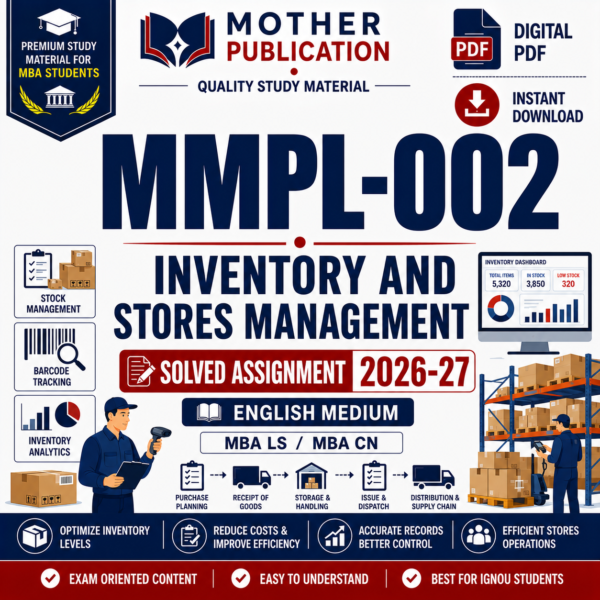
MMPL-002 Solved Assignment 2026-27 in English is prepared for students studying Inventory and Stores Management under the applicable IGNOU MBA programmes.
The uploaded PDF identifies MMPL-002 as Inventory and Stores Management, with All Blocks coverage. It is labelled SOLVED ASSIGNMENT 2026-27 and specifies 31 October 2026 as the last date for the July 2026 session and 30 April 2027 for the January 2027 session.
IGNOU’s current assignment listing confirms MBALS and MBACN, English medium, July 2026 and January 2027, with 100 maximum marks for MMPL-002.
IGNOU’s official programme pages identify MMPL-002 as Inventory and Stores Management, a 4-credit theory course under both the MBA (Logistics & Supply Chain Management) and MBA (Construction Management) structures.
MMPL-002 Course Information
| Particular | Details |
|---|---|
| Course Code | MMPL-002 |
| Course Title | Inventory and Stores Management |
| Programme Codes | MBALS, MBACN |
| Programme | MBA (Logistics & Supply Chain Management) / MBA (Construction Management) |
| Degree | Master of Business Administration |
| Medium | English |
| Session | 2026-27 |
| Assignment Code | MMPL-002/TMA/JUL/2025* |
| Coverage | All Blocks |
| Maximum Marks | 100 |
| Credits | 4 |
| Course Type | Theory |
*The assignment code is reproduced exactly as shown in the uploaded source PDF. The document itself is labelled Solved Assignment 2026-27.
MMPL-002 Solved Assignment 2026-27 Overview
MMPL-002 Solved Assignment 2026-27 in English covers important concepts related to inventory planning, stores management, material requirements planning, economic order quantity and strategic inventory control.
The assignment contains five main questions, each divided into parts (a) and (b). The major topics include:
- ABC Analysis
- VED Analysis
- ABC-VED Matrix
- Safety Stock
- Reorder Level
- Stores Management
- MRP-I
- MRP-II
- Bill of Materials
- Master Production Schedule
- EOQ
- Inventory types
- Strategic Inventory Control
These topics are directly covered in the uploaded assignment.
MMPL-002 Assignment Questions
Question 1 — Inventory Control Techniques
(a) ABC Analysis and VED Analysis
The assignment asks students to compare ABC Analysis, which is value-based, with VED Analysis, which is criticality-based, and explain how both can be integrated into an ABC-VED Matrix for optimal resource allocation.
The solved material explains that:
- ABC Analysis classifies inventory according to annual consumption value.
- A items have high monetary value and require strict control.
- B items have moderate value.
- C items have low value and require comparatively simple control.
- VED Analysis classifies materials according to operational importance.
- Vital items are indispensable.
- Essential items are important but can tolerate limited shortages.
- Desirable items have comparatively lower criticality.
The ABC-VED Matrix combines both dimensions and helps managers give maximum attention to costly and/or highly critical items.
Question 1(b) — Safety Stock and Reorder Level
The assignment also asks students to distinguish between Buffer Stock (Safety Stock) and Reorder Level (ROL) and explain the impact of supply lead-time variations on the reorder point.
The solved material explains that safety stock protects against uncertainties such as:
- Unexpected demand
- Supplier delays
- Transportation problems
- Production interruptions
The Reorder Level is the inventory level at which a replenishment order is placed.
When lead time becomes uncertain or increases, organisations generally need higher safety stock and a higher reorder level to prevent stock-outs.
Question 2 — Stores Management
(a) Operational Functions of Stores
The assignment uses the statement:
“A poorly managed storehouse acts as a leaky bucket for corporate capital.”
It asks students to explain the essential operational functions of stores management from receipt to issue.
The solved material covers:
- Receipt of materials
- Inspection
- Documentation
- Storage
- Stock control
- Preservation
- Material issue
- Stock verification
- Record maintenance
Proper receiving procedures include verification of purchase orders, delivery documents, quantity, quality and condition.
Question 2(b) — Systematic Store Processes
The assignment asks how systematic store processes ensure transparent records, physical loss prevention and audit readiness.
The solved material discusses:
- Stock registers
- Bin cards
- Stores ledgers
- Computerised inventory systems
- Secure storage
- Restricted access
- Surveillance
- Regular stock verification
- Reconciliation
- Segregation of duties
- Authorisation procedures
- Audit documentation
These processes improve accountability and allow inventory transactions to be traced from purchase through consumption.
Question 3 — MRP-I and MRP-II
(a) Material Requirements Planning
The assignment asks students to distinguish between MRP-I and MRP-II and explain how they collectively improve inventory accuracy and production alignment in volatile markets.
MRP-I
MRP-I primarily focuses on:
- Material requirements
- Inventory planning
- Purchase planning
- Material availability
It uses inputs such as the Master Production Schedule (MPS), Bill of Materials (BOM) and inventory records.
MRP-II
MRP-II expands the concept by integrating:
- Production planning
- Capacity planning
- Labour
- Machine utilisation
- Finance
- Purchasing
- Shop-floor control
Together, MRP-I and MRP-II improve inventory accuracy, resource utilisation and production responsiveness.
Question 3(b) — BOM and MPS
The assignment asks about the role of the Bill of Materials (BOM) and Master Production Schedule (MPS) as primary inputs to an MRP system.
Bill of Materials
The BOM identifies all:
- Raw materials
- Components
- Sub-assemblies
- Parts
required to manufacture a finished product.
Master Production Schedule
The MPS specifies:
- What finished products must be produced
- Quantity to be produced
- When production should take place
Together, the BOM and MPS enable accurate material planning, procurement and production scheduling.
Question 4 — Economic Order Quantity
(a) EOQ Model
The assignment asks students to state the core objective of the Economic Order Quantity (EOQ) model, derive the basic EOQ formula and explain its assumptions.
The primary objective of EOQ is to determine the order quantity that minimises total inventory cost by balancing:
- Ordering Cost
- Carrying/Holding Cost
The basic formula is:
EOQ = √(2DS/H)
where:
- D = Annual demand
- S = Ordering cost per order
- H = Holding cost per unit per year
The basic EOQ model assumes known and constant demand, fixed lead time, immediate replenishment, no stock-outs, constant ordering cost, constant carrying cost and an unchanged unit purchase price.
Question 4(b) — EOQ Numerical
The assignment provides:
- Annual demand = 12,000 units
- Ordering cost = ₹600/order
- Unit price = ₹100
- Carrying cost = 20%
Therefore:
Carrying cost = 20% × ₹100 = ₹20 per unit/year
Using:
EOQ = √(2DS/H)
The solved calculation gives:
EOQ ≈ 848.53 units
Therefore, the practical order quantity is approximately:
EOQ ≈ 849 units
The annual ordering cost is approximately ₹8,485, and annual carrying cost is approximately ₹8,485.
Therefore:
Total Minimum Variable Inventory Cost ≈ ₹16,970 per year
Question 5 — Strategic Inventory Management
(a) Functions and Types of Inventory
The assignment asks students to critically evaluate the statement that inventory can become a “graveyard” for businesses while its absence can paralyse supply-chain operations.
The solved material identifies several strategic functions of inventory:
- Supporting uninterrupted production
- Meeting customer demand
- Protecting against supply uncertainty
- Handling demand fluctuations
- Obtaining quantity discounts
- Reducing ordering costs
- Supporting distribution
- Improving customer satisfaction
Types of Inventory
The assignment material covers:
- Raw Material Inventory
- Work-in-Progress Inventory
- Finished Goods Inventory
- MRO Inventory
- Safety Stock
- Cycle Stock
- Pipeline Inventory
Excessive inventory increases carrying costs and risks of damage or obsolescence, while insufficient inventory can result in production interruptions, emergency purchases, lost sales and dissatisfied customers.
Question 5(b) — Strategic Inventory Control
Strategic inventory control aims to balance three important objectives:
1. Cost Efficiency
Inventory control reduces unnecessary investment, storage costs, insurance, handling costs and depreciation. Techniques such as EOQ, ABC Analysis and JIT can help optimise inventory.
2. Customer Satisfaction
Maintaining appropriate inventory ensures product availability and timely delivery. Safety stock can protect against sudden demand increases and supply disruptions.
3. Operational Continuity
Adequate inventory protects production against supplier failures, transportation delays, labour disruptions and other uncertainties.
Modern organisations can use ERP systems, RFID, real-time monitoring, demand forecasting and digital inventory-management systems to balance these objectives.
MAJOR TOPICS COVERED IN MMPL-002
Inventory Control
- ABC Analysis
- VED Analysis
- ABC-VED Matrix
- Safety Stock
- Reorder Level
- Lead-Time Variation
Stores Management
- Material Receipt
- Inspection
- Documentation
- Storage
- Preservation
- Material Issue
- Stock Verification
- Audit Readiness
Material Planning
- MRP-I
- MRP-II
- BOM
- MPS
Inventory Cost Management
- EOQ
- Ordering Cost
- Carrying Cost
- Minimum Variable Inventory Cost
Strategic Inventory
- Raw Materials
- Work-in-Progress
- Finished Goods
- MRO Inventory
- Safety Stock
- Cycle Stock
- Pipeline Inventory
- Strategic Inventory Control
These topics are covered across all five questions in the uploaded solved assignment.
KEY FEATURES
- MMPL-002 Inventory and Stores Management
- Solved Assignment 2026-27
- English Medium
- Applicable to MBALS and MBACN
- July 2026 + January 2027 cycle
- All Blocks coverage
- 100 marks
- 4 credits
- Complete five-question coverage
- Structured reference answers
- EOQ numerical solution included
- Digital PDF
- Instant Download
- Mobile-friendly PDF
- Useful for academic preparation and reference
WHO CAN USE MMPL-002?
MMPL-002 is applicable to:
- MBALS — MBA (Logistics & Supply Chain Management)
- MBACN — MBA (Construction Management)
IGNOU’s current assignment listing confirms both programme codes for MMPL-002.
IGNOU’s official programme pages also show Inventory and Stores Management (MMPL-002) in both programme structures.
HOW TO GET MMPL-002 SOLVED ASSIGNMENT PDF
Step 1: Select the Product
Select MMPL-002 Solved Assignment 2026-27 in English.
Step 2: Verify Your Course
Confirm:
MMPL-002 — Inventory and Stores Management
Also verify your programme, session and English medium.
Step 3: Complete Checkout
Add the product to your cart and complete the available payment process.
Step 4: Access the Digital PDF
After successful payment, access the digital product through the website’s delivery system.
Step 5: Download and Prepare
Download the PDF and use the structured answers for academic preparation and reference.
FREQUENTLY ASKED QUESTIONS
1. What is MMPL-002?
MMPL-002 is Inventory and Stores Management. IGNOU lists it as a 4-credit theory course.
2. Which programmes include MMPL-002?
MBALS and MBACN.
3. What is the course title?
Inventory and Stores Management.
4. What is the medium?
The current IGNOU assignment is available in English.
5. What is the maximum marks?
The current assignment listing shows 100 marks.
6. How many credits does MMPL-002 carry?
MMPL-002 carries 4 credits.
7. What are the major topics?
Major topics include ABC Analysis, VED Analysis, Safety Stock, Reorder Level, Stores Management, MRP-I, MRP-II, BOM, MPS, EOQ and Strategic Inventory Control.
8. What is the EOQ calculated in the assignment?
The solved numerical gives an EOQ of approximately 849 units.
9. What is the minimum variable inventory cost in the EOQ question?
The solved calculation gives approximately ₹16,970 per year.
10. What is the July 2026 submission date?
The uploaded assignment states 31 October 2026.
11. What is the January 2027 submission date?
The uploaded assignment states 30 April 2027.
DISCLAIMER
Mother Publication independently prepares this material for educational and reference purposes. Students should read, understand and appropriately use the material while preparing their assignments. Mother Publication is not affiliated with, endorsed by, or officially associated with IGNOU.
PRODUCT TAGS
MMPL-002, MMPL 002, MMPL002, MMPL-02, MMPL 02, MMPL02, MMPL-2, MMPL 2, MMPL2, MMPL-002 Solved Assignment 2026-27, MMPL 002 Solved Assignment 2026-27, MMPL002 Solved Assignment 2027, MMPL-2 Solved Assignment 2027, MMPL 2 Assignment 2027, MMPL2 Solved Assignment 2026-27, MMPL-002 Assignment 2026-27, MMPL-002 Solved Assignment 2027, MMPL-002 English Assignment, MMPL-002 Assignment PDF, MMPL-002 Solved PDF, Inventory and Stores Management Assignment, Inventory and Stores Management Solved Assignment, Inventory and Stores Management PDF, Inventory and Stores Management 2026-27, Inventory and Stores Management English, MBA Inventory and Stores Management Assignment, MBA Inventory Assignment, MBA Stores Management Assignment, MBALS MMPL-002, MBACN MMPL-002, MBA LS MMPL-002, MBA CN MMPL-002, MMPL-002 July 2026, MMPL-002 January 2027, MMPL-002 2026-27, MMPL 002 2027, MMPL002 2027, MMPL-002 TMA July 2026, MMPL-002/TMA/JUL/2025, MMPL-002 Inventory and Stores Management, MMPL-002 Solved Assignment English Medium, MMPL-002 Digital PDF, MMPL-002 Assignment Answers, Inventory and Stores Management Solved PDF, MMPL-002 TMA 2026, MMPL-002 Assignment Answers 2026-27